
Literature
-
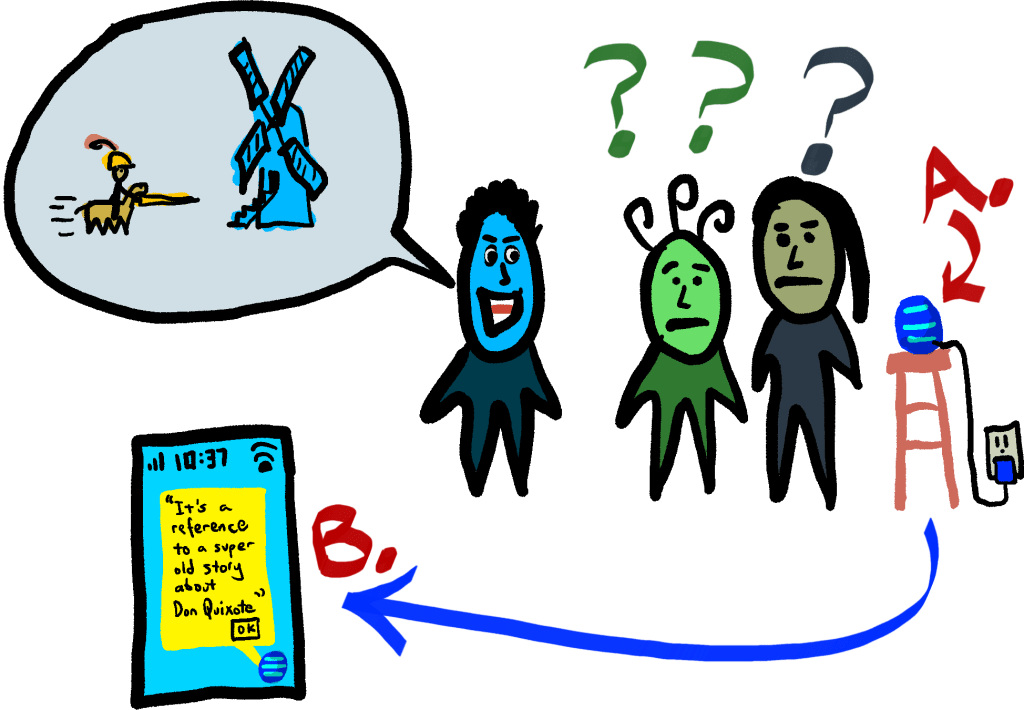
Background: Sometimes, people make references (“literary allusions,” if you prefer) to well-known books, movies, or other shared cultural elements. If the listener recognizes the reference, this can either be a convenient shorthand for describing something: e.g. “it’s a ‘Groundhog Day’ situation“ instead of “it seems like a scenario in which the same occurrence repeats over…
-

Background: In ancient times, there was the “scroll,” which is basically a super inconvenient book where you can’t arbitrarily access information on a particular “page” without some laborious scrolling. Later, the “codex”—or “regular book”—was invented. It’s basically a stack of identically-shaped pieces of paper that are bound together on one side. So far, so good.…
-

Proposal: Illustrated children’s books usually consist of two main things: Unfortunately, books written before the advent of computer-generated images are stuck with “stale” illustrations: each page contains a single fixed image that will never change. But thanks to machine learning, we can fix this! Observe the new style of children’s book, where instead of an…
-

Background: It has become increasingly difficult for poets to make a living in the modern world. This is probably because all the “good” rhyming words have already been used, leaving modern poets to scavenge for scraps. Fortunately, there are still many English words that are notoriously hard to rhyme: for example, “orange,” “beige,” “walrus,” “circle,”…
-

Background: People occasionally keep a diary or journal as in order to record the events of their life and, ideally, reflect on them in a positive manner. The Issue: Unfortunately, the process of keeping a diary requires discipline and dedication. It can be easy for someone to get out of the routine of keeping a…
-

Background: When you’re the admiral of an 18th-century navy and you want to communicate with the many other boats in your fleet, what are you going to do? Obviously you can’t just send text messages to the other captains, since you’re in the middle of the ocean and won’t have any cell reception. The answer…
-
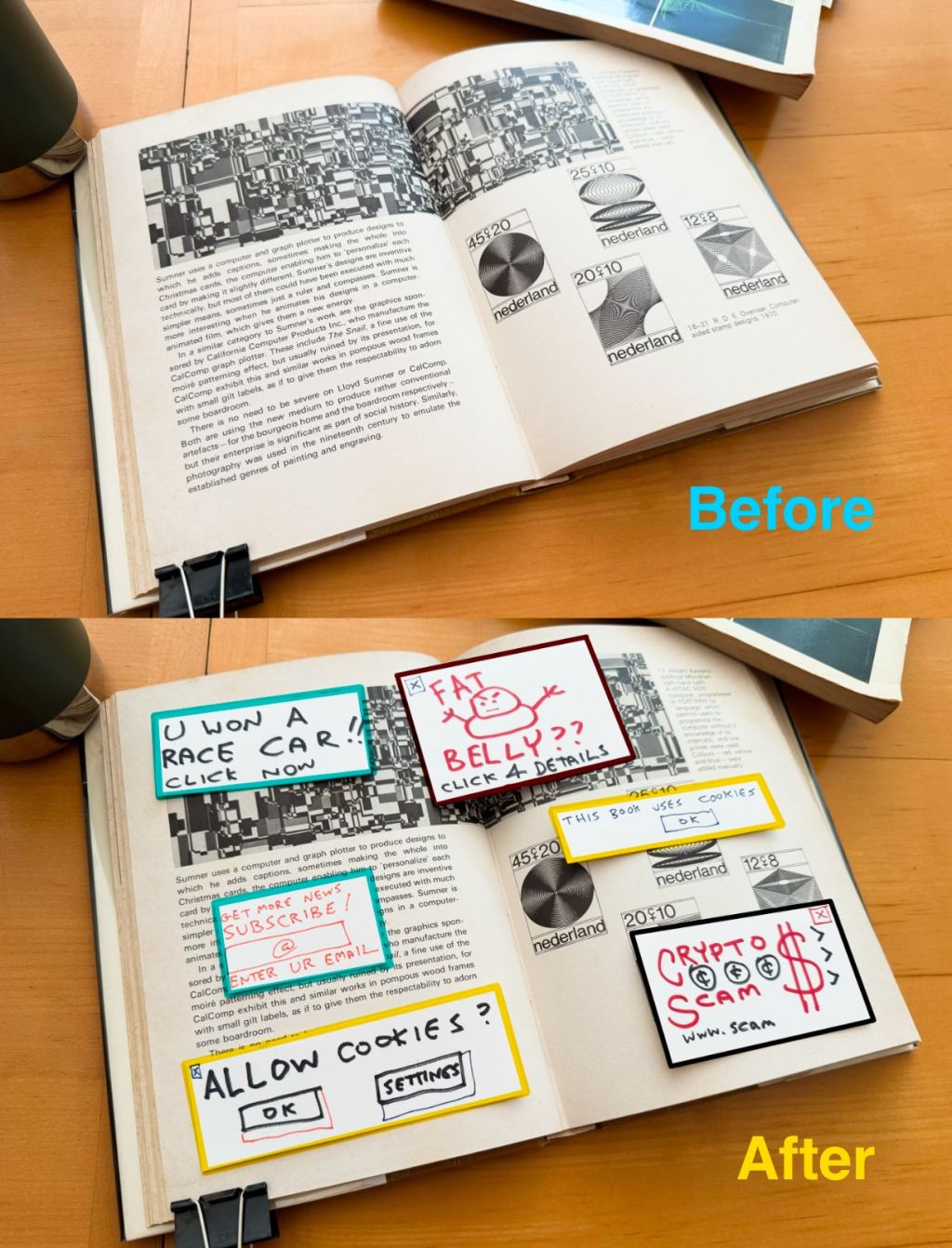
The Issue: The book-reading experience has not fundamentally changed in hundreds of years. What if we could “modernize” the experience by bringing the experience of reading articles on the web (Figure 1) to the physical-book form factor? Proposal: The solution is simple: a “normal” book can be enhanced with the normal bonus features of Internet…
-
Background: It turns out that groups of people can have shockingly long memories when it comes to historical grievances. Thanks to the power of literacy, people might retain the memory of a “score to settle” for something that happened 50, 100, or even 1000 years ago! The Issue: You (or someone you know) might have…
-
Background: English has a few options for conveying the tone of speech in a sentence by using different letters (Figure 1): italics or bold emphasize a word, capital letters EXPRESS ENTHUSIASM OR ANGER, and a tiny font indicates that, I don’t know, maybe a mouse is speaking. But that’s about it! There is no specific…
-
Background: It’s time-consuming to learn a language. It’s also generally advantageous for a language to have as many speakers as possible, since more speakers means more chance of being able to use a language in a given situation. (In the extreme case, a “secret” language that only one person knew would have very minimal utility.)…
 WorstPlans: updated every Monday since July 2014!