
Background:
Now that seemingly EVERY computer text input field is “A.I.-enhanced,” it can be somewhat difficult to remember which part of a document was generated by an AI, and which part has actually been reviewed by a human.
The Issue:
The classic response to this is “well just DON’T USE THE A.I. THEN!!” But it can be fairly useful to, say, start a document with something like “Write a letter complaining about the poor-quality copper that you received in a recent shipment.”
(The old-fashioned version of this would be to first look around for existing similar letters, and adapt one of those.)
So the problem is that a person might start a document with an AI prompt, start to revise it, and then lose track of which parts were human-generated and which parts were AI-generated.
Proposal:
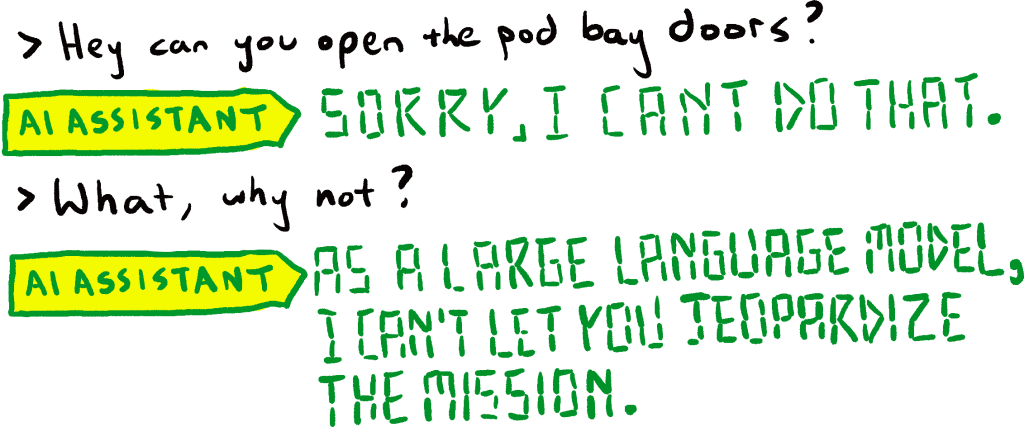
It’s possible to solve this issue in several ways, but the easiest would be to actually have AI-generated text be produced in a completely different font, as shown in Figure 1:
Alternatives:
One problem is that fonts are also easily changed accidentally: a user might just change the font used in their entire document and thereby accidentally lose the “which section was AI-generated” info.
This could be solved by using entirely different Unicode characters for AI-generated text. There are many options for this, ᔕᑌᑕᕼ ᗩᔕ TᕼIᔕ E᙭ᗩᗰᑭᒪE, 🅾🆁 🅼🅰🆈🅱🅴 🆃🅷🅸🆂 🅾🅽🅴. (This has the advantage of surviving any font / formatting changes.)
Or, perhaps slightly easier, we can just adopt a new convention worldwide: henceforth, humans can only type lower-case letters, and AI models can only produce upper-case letters.
PROS: Finally, the bizarrely redundant set of upper/lower-case Latin letters can serve a useful purpose!
CONS: Deprecating upper-case letters for human use might be a bit controversial.
Originally published 2025-04-14.


You must be logged in to post a comment.