
Background:
Sometimes, restaurant menus will list a dish as “market price,” rather than giving a specific set price. (This is most commonly seen for seafood.) In such a situation, a diner would have to inquire as to what the specific price would be on a given day, based on the relative supply and demand of that fish.
The Issue:
Strangely, despite the fact that a large fraction of people apparently LOVE gambling on everything (witness the recent rise of “prediction markets”), the “market price” concept remains a very niche concept generally reserved for high-end seafood.
But that can be changed!
Proposal:
Let’s bring the idea of “buy low / sell high” and market demand to even the cheapest fast food meals!
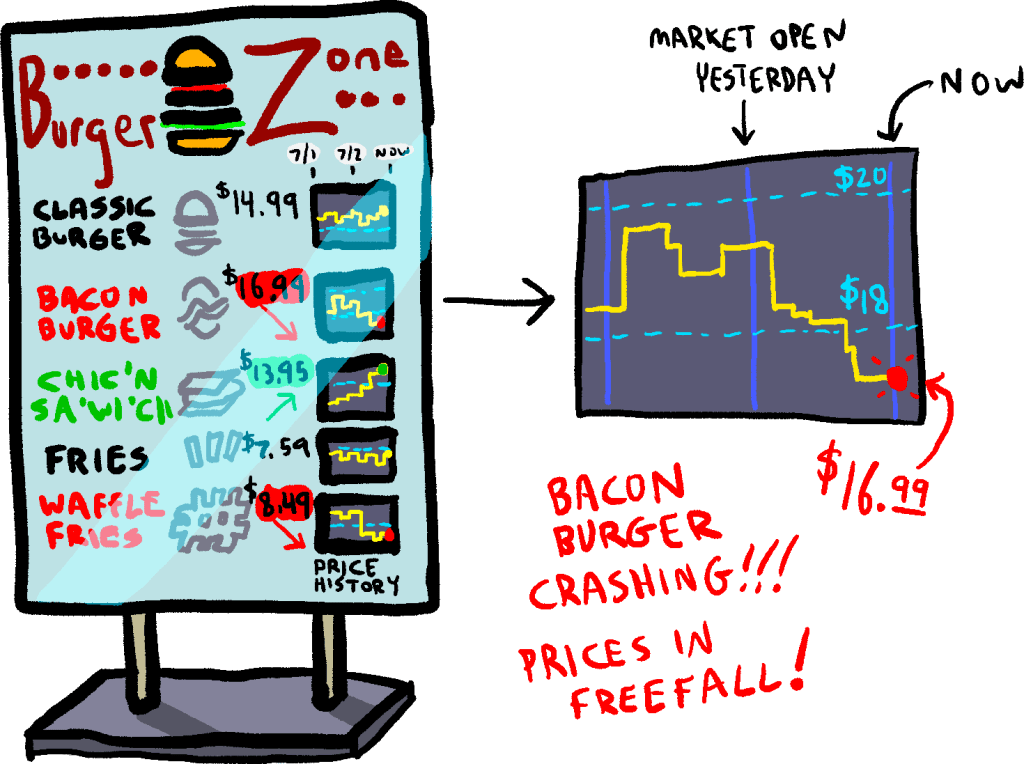
This would be simple: the menus are simply updated with a stock-market-like chart that shows the recent demand for various foods. As more people order a popular menu item, the price will automatically increase to match (Figure 1).
Conclusion:
This new “demand-based pricing” system has several advantages:
- It lets people indulge their desire to be degenerate gamblers in a mostly harmless way.
- It helps people branch out and try new foods. Instead of just always ordering the same meal, a person might be enticed to try a new food where the price had plummeted precipitously but “the fundamentals” were still solid.
- It lets the company semi-arbitrarily set prices and try to extract as much money as possible from the consumer without feeling compelled to justify the price change. This approach has already been VERY successfully used by some Texas utility companies (https://www.google.com/search?q=texas+utility+rates+thousands+of+dollars+demand+pricing) to bill users thousands of dollars for “market price” residential electricity in unusual circumstances.
PROS: Provides a new and mentally-engaging way to pay more money for food!
CONS: If the price is constantly changing, it may be very confusing: a person could get to the register with the idea of paying $80 for a meal, only to find that a sudden demand spike has sent prices skyrocketing to $800 in the last 30 seconds.
Originally published 2026-02-09.
 WorstPlans: updated every Monday since July 2014!
You must be logged in to post a comment.