
Background:
Haunted houses are a Halloween experience that can range from extremely cheap and homemade (“this bowl of grapes is… human eyeballs!!!”) to extremely expensive and professional (e.g. Disney’s Haunted Mansion, although that’s not technically a “Halloween” experience).

The goal of a haunted house is to evoke a feeling in the attendees that may range from “mildly unsettling” to “blood-chillingly terrifying.”
Proposal:
Thanks to modern computers and the unsettlingly fast development of Orwellian surveillance technology, it is now possible to create a new type of haunted house attraction: inserting the face of the actual haunted house attendees in props in the haunted house.
The system is simple: at the entrance to the haunted house, a camera gets a good look at the incoming visitors.
Then, a computer uses modern deepfake technology to create a digital version of each visitor, but with a slight twist: “as a vampire in a gothic portrait” or “as an engraving on a tombstone.” (This can almost certainly be done in less than 15 seconds.) These haunted images are then projected onto props in the haunted house (Figure 2).
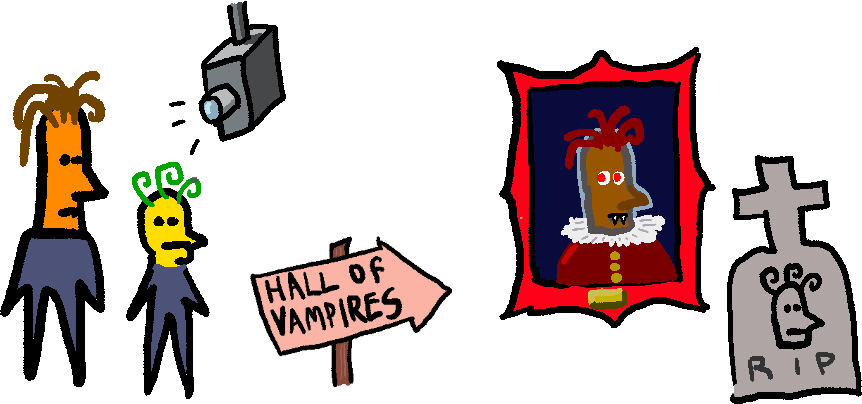
You could even do some sort of really fancy 3D mapping and match the visitor’s own face onto a vaguely similar mannequin, although this is probably out of the range of the budget of a neighborhood haunted house.
Conclusion:
Compute costs could be kept low by running the image generation locally. This is probably totally feasible!
PROS: Increases the unsettling-ness factor of a haunted house, with no moving parts required!
CONS: Furthers the day when humans are obsolete, replaced entirely by AI?? Maybe that’s the TRUE horror of this AI-enabled haunted house.
Originally published 2026-02-02.


You must be logged in to post a comment.