Proposal:
Illustrated children’s books usually consist of two main things:
- Some easy-to-read words
- An illustration that is (hopefully) of interest to a child
Unfortunately, books written before the advent of computer-generated images are stuck with “stale” illustrations: each page contains a single fixed image that will never change.
But thanks to machine learning, we can fix this! Observe the new style of children’s book, where instead of an illustration, a QR code is present that links to an image generation prompt (Fig. 1a).
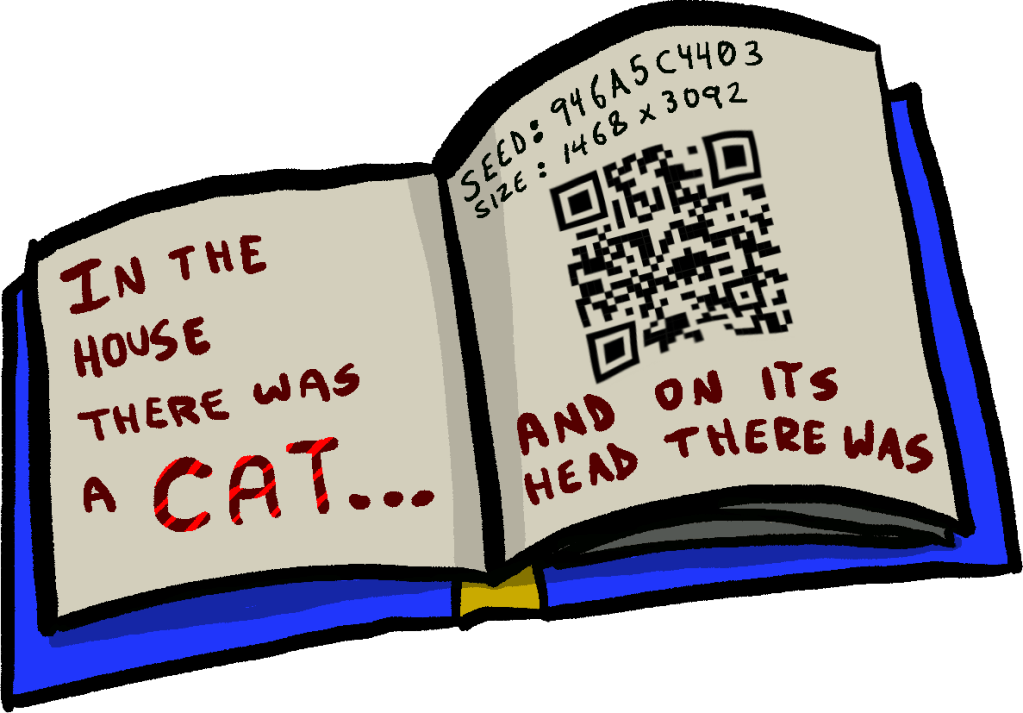
By changing the random number “seed,” a slightly different image can be created.
As an added bonus, it is very easy to reword a prompt if, for example, it turns out that the children’s book may have slightly promoted genocide / slavery / cannibalism / whatever (for a concrete example, see the revisions to the Oompa-Loompas from Charlie and the Chocolate Factory). In this fashion, a no-longer-socially-acceptable illustration can be redone in seconds by AI, rather than requiring complete re-illustration.
Example 1: “A Legally-Distinct Cat in a Hat”

PROMPT: a black cartoon cat wearing a red and white striped hat, a children’s book illustration, style of dr seuss, dr seuss, seuss, illustration, children’s book, crayon
NEGATIVE PROMPT: realistic
Example 2: “Goodnight To A Celestial Body Orbiting Earth”
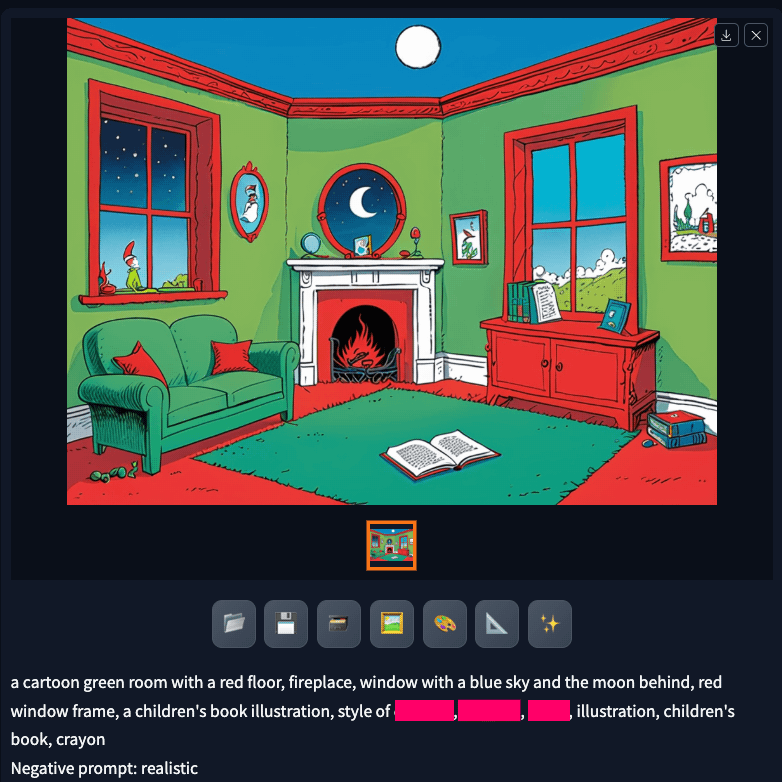
PROMPT: a cartoon green room with a red floor, fireplace, window with a blue sky and the moon behind, red window frame, a children’s book illustration, style of dr seuss*, dr seuss*, seuss*, illustration, children’s book, crayon
NEGATIVE PROMPT: realistic
[*] This book was not illustrated by Dr. Seuss, but the prompt includes that term anyway to get a flat cartoony style.
Example 3: “Two Fish, One Fish, Blue Fish, Red Fish”

Fig. 3: Another example (arguably slightly less successful than the preceding two). This one is a ripoff of “One Fish, Two Fish, Red Fish, Blue Fish” (1960).
PROMPT: a white cartoon fish, two green cartoon fish, one cartoon red fish, one cartoon blue fish, yellow background, ocean waves at bottom, a children’s book illustration, style of dr seuss, dr seuss, seuss, illustration, children’s book, crayon
NEGATIVE PROMPT: realistic
Conclusion:
This is the future of art!
PROS: Children will love it! Adults may also appreciate the increased variety of illustrations.
CONS: Requires that the reader have a cell phone or VR headset. Presumably this will be the default in the future, so it’s not really a downside at all. Maybe VR headsets of the future will just seamlessly replace all QR codes with an image anyway, saving the user from having to manually input them!
Originally published 2024-11-18.
 WorstPlans: updated every Monday since July 2014!
You must be logged in to post a comment.