
Background:
One major concern for any civilization that lasts for more than a few billion years is: what is the best long-term method to reliably store and retrieve energy?
Solar panels on a planet work great, but only capture a tiny fraction of total solar output. Some ideas exist for working around this (Figure 1), but typically they require an impractically-large number of resources to construct.

The Issue:
Even more vexingly, a star is an annoying way of storing energy: it ALWAYS has to be “on,” and it is prone to exploding or burning out in less than 10 trillion years.
Ideally, we want a power source that can be turned off and on as needed. For example, if you needed to make some toast AND run a space heater AND power a gaming PC, you might want to turn the star on, but at night you’d ideally want to turn it off to save energy.
Proposal:
Luckily, nature has provided a solution: the humble neutron star (Figure 2).
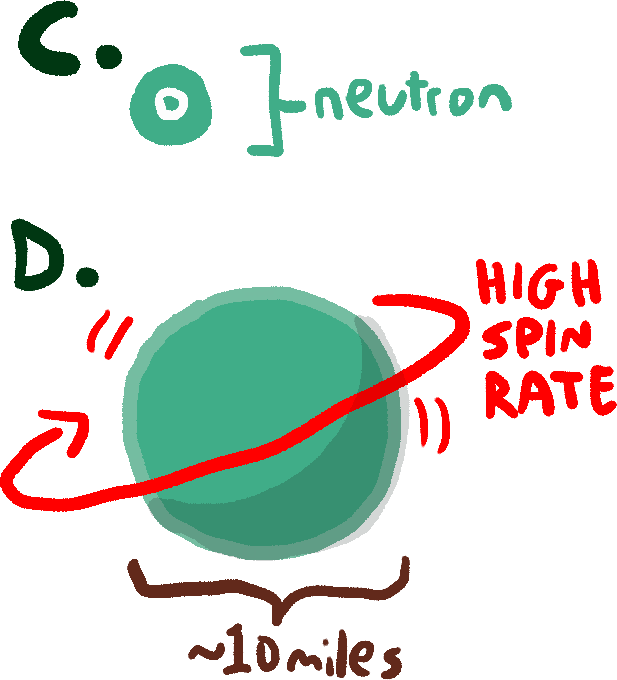
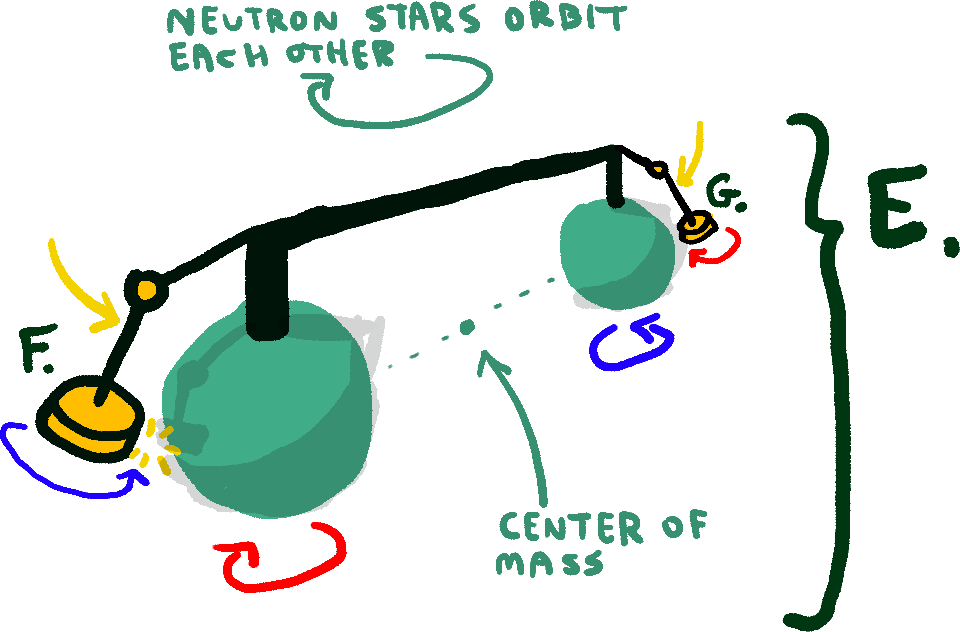
What we would like to do is take a neutron star and use it like a flywheel: ideally, we would mesh it with a gear and siphon off just a little bit of rotational energy on an as-needed basis.
The only problem here is that the action of “spinning up” a meshed gear is also going to cause the gear to want to zoom along the surface of the neutron star. In order to counteract this motion, we’ll actually need TWO neutron stars (rotating in opposite directions) in orbit around each other (Figure 3).
Long-term practicality:
Let’s do the math of how much energy is available from the spinning of a neutron star. Apparently, we have to multiply the spin rate by something called the “moment of inertia.” For a solid sphere (like our neutron star), this is evidently:
- Moment of Inertia 𝐼 = ⅖ × m × r²
(from https://en.wikipedia.org/wiki/List_of_moments_of_inertia), where the variables are:
- Approximate mass (“m”): 3 × 10³⁰ kilograms
- Radius: ~8,000 meters (~5 miles)
Which gives us:
- 𝐼 = ⅖ × m × r²
- 𝐼 = ⅖ × 3 × 10³⁰ kg× (8000 m)²
Now we just need to multiply that by the angular velocity in radians per second. If you get a REALLY good neutron star, the rotation rate is ~700 times per second, or, in other words:
- Angular velocity = (700 × 2𝜋) radians / second = 4,398 radians / second
If we want the total energy (“𝐸”), the Internet says that we apparently multiply the “moment of inertia” by the angular velocity, which gives us the following:
- 𝐸 = ½ × 𝐼 × (angular velocity)²
- 𝐸 = ½ × ⅖ × 3 × 10³⁰ kg× (8,000 m)² × (4,398 radians / second)²
- 𝐸 = 7.4 × 10⁴⁴ joules
If we believe the Internet estimates, which I’m too lazy to check right now, civilization currently consumes approximately 6 × 10²⁰ joules per year. If we divide (7.4 × 10⁴⁴ joules) by (6 × 10²⁰ joules / year), we end up with ~10²⁴ years per neutron star, which is a trillion times a trillion years. Substantially more than you’d get from pretty much any regular star!
PROS: Good long-term solution for providing reliable power. Power draw can be scaled up/down as needed.
CONS: Material science may be ill-equipped to handle the unusually high gravitational forces around neutron stars. Those material scientists had better get cracking!!! Might also be sabotaged by politicians who are in the pocket of “Big Dyson Sphere.”
Originally published 2026-07-13.


You must be logged in to post a comment.