
Background:
“Augmented reality” (“AR”) headsets (e.g. the Oculus/Meta Quest or the Apple Vision Pro) are capable of overlaying computer screens on top of a view of the real world. From the perspective of the headset-wearer, the virtual screens can entirely cover up any real world objects behind them.
The Issue:
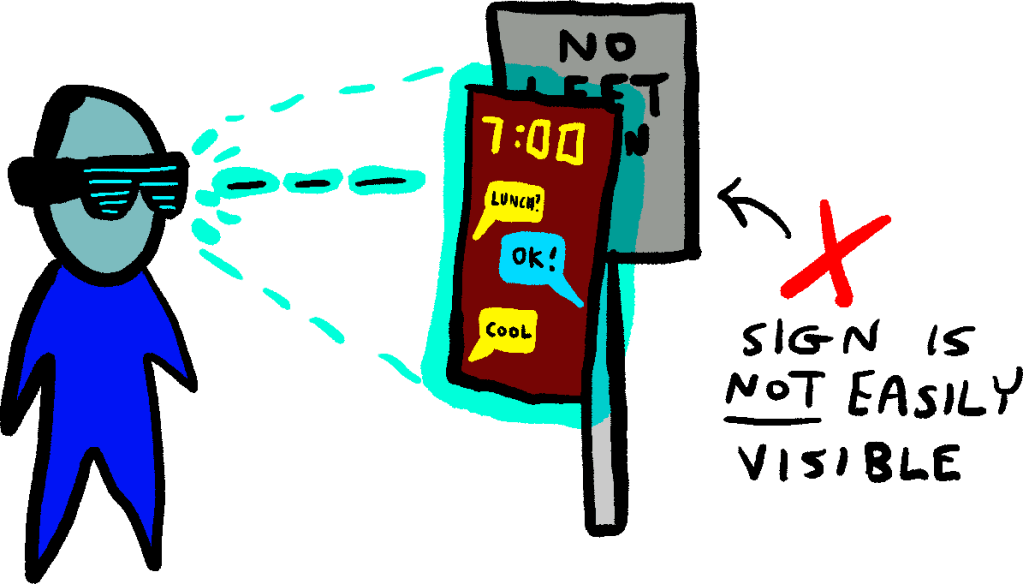
If a person wears an AR headset while walking around, they’re likely to walk into an obstacle or get run over by a car due to the reduction in situational awareness.
Figure 1 illustrates how how it might be distracting to have a giant floating screen projected into the world:
Proposal:
One might propose making the virtual windows slightly transparent, or restricting them to be a certain size. However, these solutions still leave a distracting and reality-obscuring “magically hovering” screen in front of the user.
The real solution is to project the screens directly onto elements of the real world (Figure 2).
So instead of the user’s text message obscuring an obstacle, the user’s text message will be projected onto that obstacle (essentially virtually “graffiti-ing” the text message onto it).

Conclusion:
Should dramatically improve a user’s situational awareness and reduce the chance of them running into people / walls / cars / signposts / etc.
PROS: May increase public safety.
CONS: If a person is looking at a photo that gets virtually projected out into the world onto the front of a bus, the user may intuitively feel like they should step directly in front of the bus in order to get a better viewing angle. (This would most likely be a poor decision.)
Originally published 2025-09-08.
 WorstPlans: updated every Monday since July 2014!
You must be logged in to post a comment.