Background:
Apparently there exists a rarely-celebrated “Darwin Day” holiday on February 12 (https://en.wikipedia.org/wiki/Darwin_Day).
Charles Darwin is famous for looking at a bunch of weird birds—finches, specifically—and wondering if natural selection could explain the differences in their beaks.
If I remember my high school biology, the idea is that each beak type is suitable for eating a particular food source. So maybe there’s one finch with a beak that’s shaped like a pair of scissors (for opening Doritos™ bags) and another finch with a can-opener beak (so it can open discarded tuna cans).
Proposal:
Someone who is celebrating “Darwin Day” might want to bring the spirit of Darwin’s finches to their festivities…. but how?
The answer is simple: partygoers can wear custom beaks that are specially adapted to eating particular foods that will be present at the party (Figure 1).
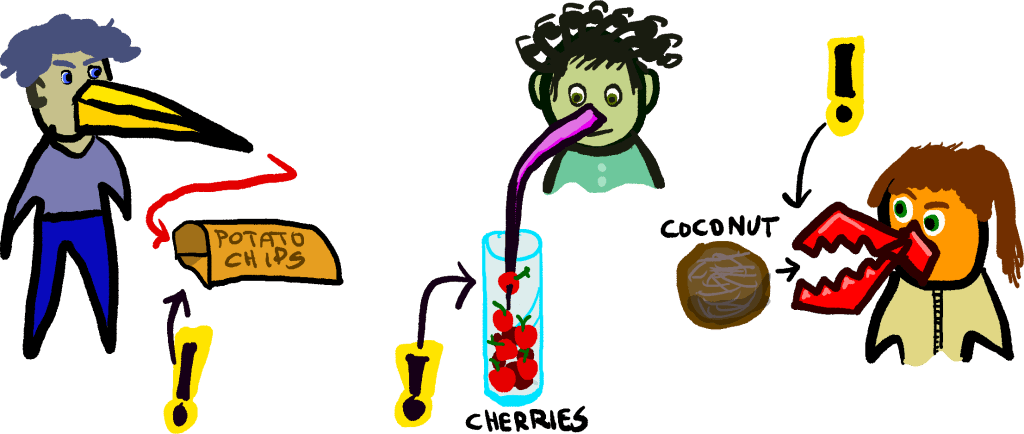
With these custom beaks, partygoers can personally experience the evolutionary pressures that led to finch beak specialization in the first place.
Additionally, since all partygoers are adapted to a specific “niche” of party food, there will be no need to fight over snacks.
Conclusion:
This idea pairs well with the Feb 16, 2015 “natural selection candy bowl” proposal. Please cross-reference that idea to further optimize your “Darwin party.”
PROS: Facilitates an educational and harmonious party atmosphere.
CONS: Significant technical hurdles remain. How does a human actually operate a beak? Remote control? Are these entirely mechanical, or do they also have motors? More research (and funding) is necessary.
Originally published 2026-03-23.
 WorstPlans: updated every Monday since July 2014!
You must be logged in to post a comment.