
Background:
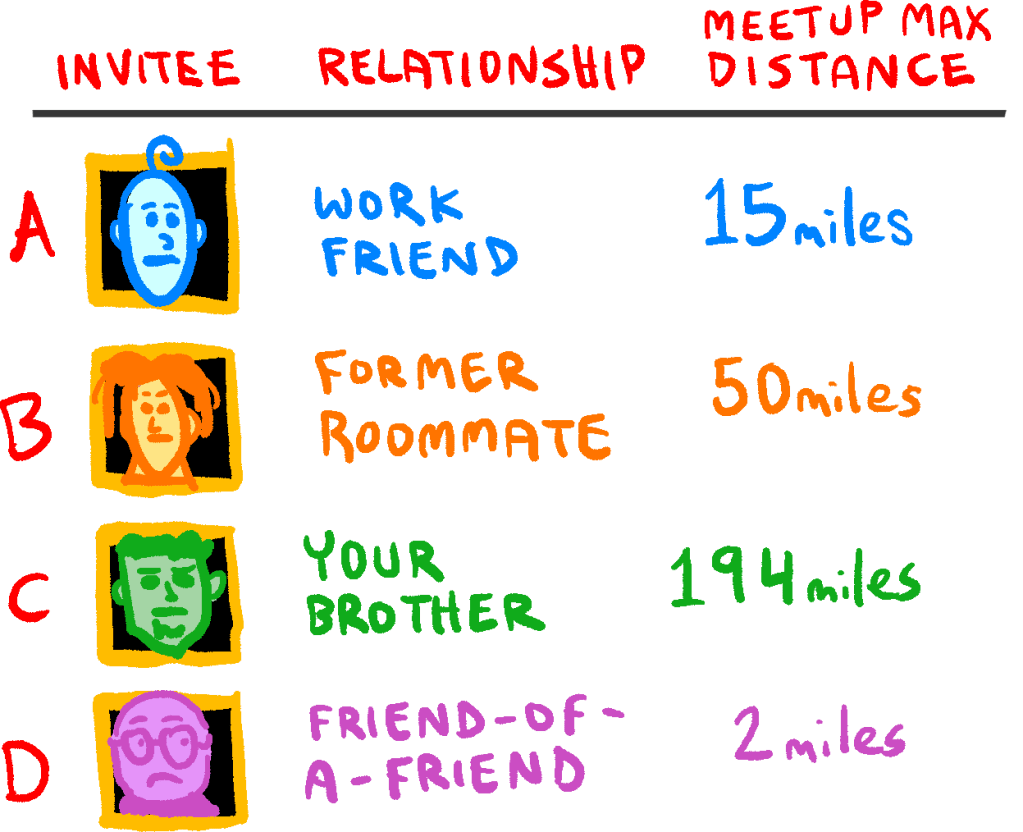
A party host might invite a guest to an event that one mile, ten miles, 100 miles, or even 1000 miles away. In most situations, the key factor in determining whether or not the guest will actually attend is the relationship between the host and guest.
For example, most people would probably drive 100 miles for a sibling’s wedding, but they’re unlikely to drive that same distance to get coffee with a work acquaintance. Depending on the relationship between people (and the importance of the event), each potential attendee has a certain maximum amount of effort that they are willing to exert in order to attend (Figure 1).
The Issue:
When planning an event, the host may have an idea of the general level of commitment of potential guests. However, if more than a few people are invited, it may become increasingly difficult to keep track of the suitability of potential meetup locations.
Proposal:
As with all problems in life, we can resolve this problem by applying MORE COMPUTER. We simply require that the event host provide two pieces of data:
- Home addresses of all prospective guests
- The strength of the host’s relationship with each guest.
(This data could probably even be obtained automatically. For example, the guest-host relationship could be automatically inferred if the computer were granted access to the host’s past messages and photos).
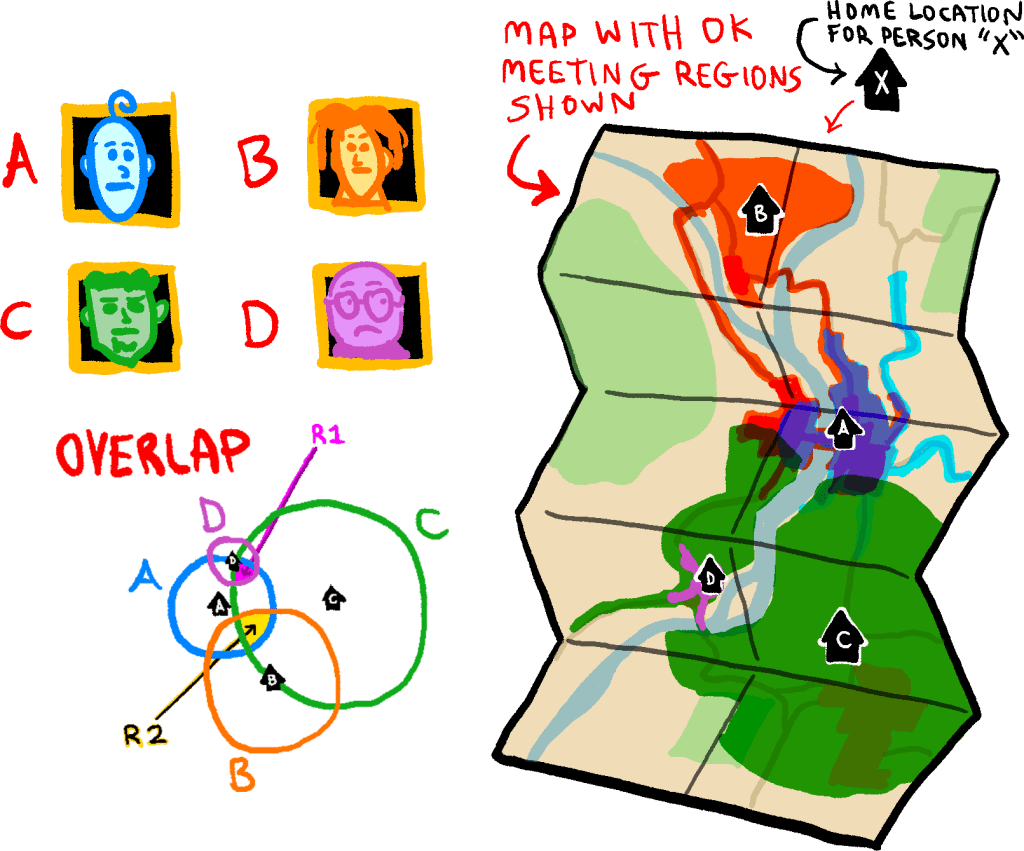
In Figure 2, we show each guests’s likely travel radius and travel “zone” on a map.
Conclusion:
This system only works for certain types of events. For example, if a couple is getting married at a specific venue, then this data visualization won’t be very useful. But for “portable” events (like a book club) that can be hosted almost anywhere, we can find the location with the best chance of good attendance.
Additional Idea:
We could also allow guests to RSVP contingent on the event location. This prevents the situation where someone says “Let’s meet for lunch!” and you say “OK!” and then they pick a place 50 miles away and you have to say “No, our friendship is only worth 28 miles of travel time!”
This way, you can be up-front about that in your RSVP, and your friend can select a location accordingly.
PROS: Helps facilitate social events and encourage friends to stay in touch.
CONS: May be disappointing to discover that your “friend” is only willing to travel 0.8 miles or less to meet you for lunch.
Originally published 2026-02-23.
 WorstPlans: updated every Monday since July 2014!
You must be logged in to post a comment.