
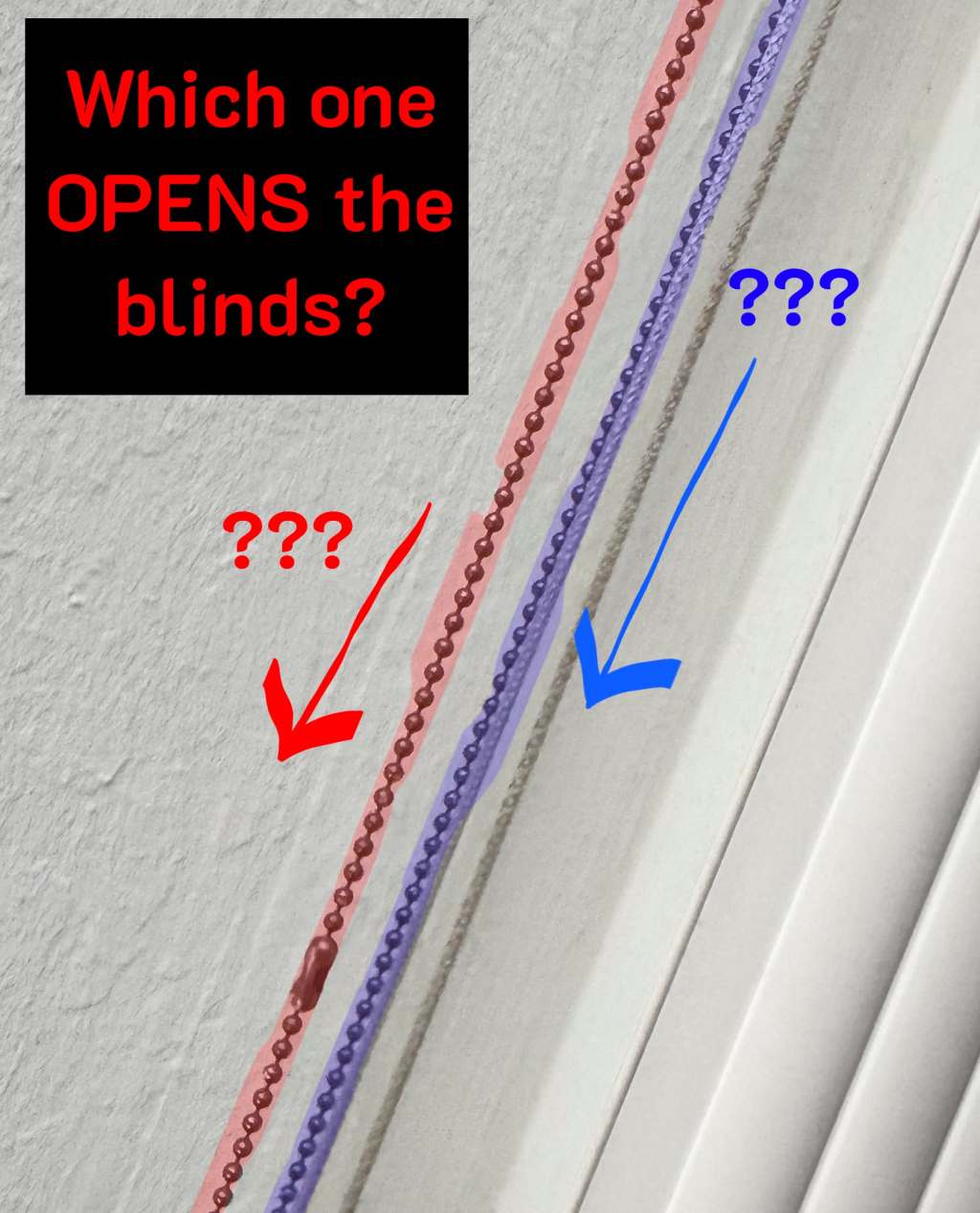
Background:
Vertical blinds (https://www.google.com/search?q=vertical+blinds) are a popular method of providing privacy for a large window or sliding door.
These blinds are usually controlled by two different looped cords:
- A fabric cord that slides the individual vertical slats back and forth. This is what a person would pull on in order to scoot all of the vertical slats out of the way.
- A beaded metal cord that can be pulled to pivot the slats 90º to quickly open/close them.
The Issue:
Unfortunately, since these cords are both loops, they really appears as TWO cords. The user must somehow know which of these unlabeled-and-often-twisted cords is the correct one to pull (as shown in Figure 1) in order to perform the desired open/close action.
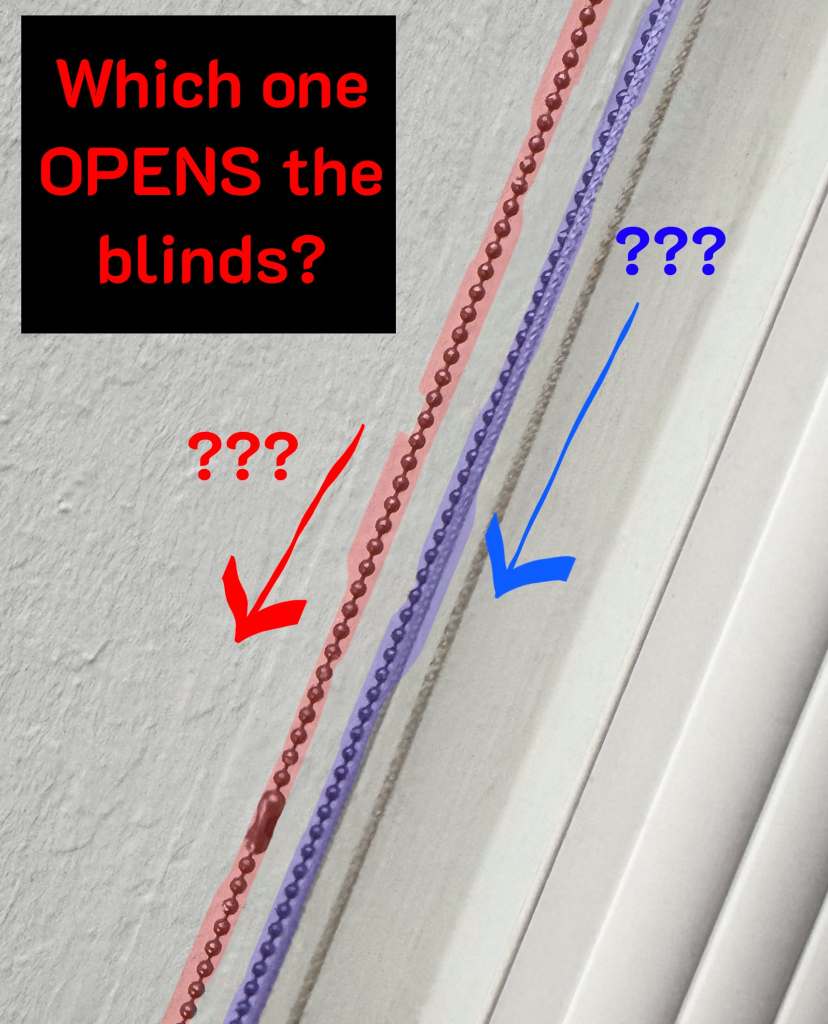
Proposal:
The solution is simple: the “open” and “close” part of cord can just be specially marked, for example, with a twist tie (Figure 2).
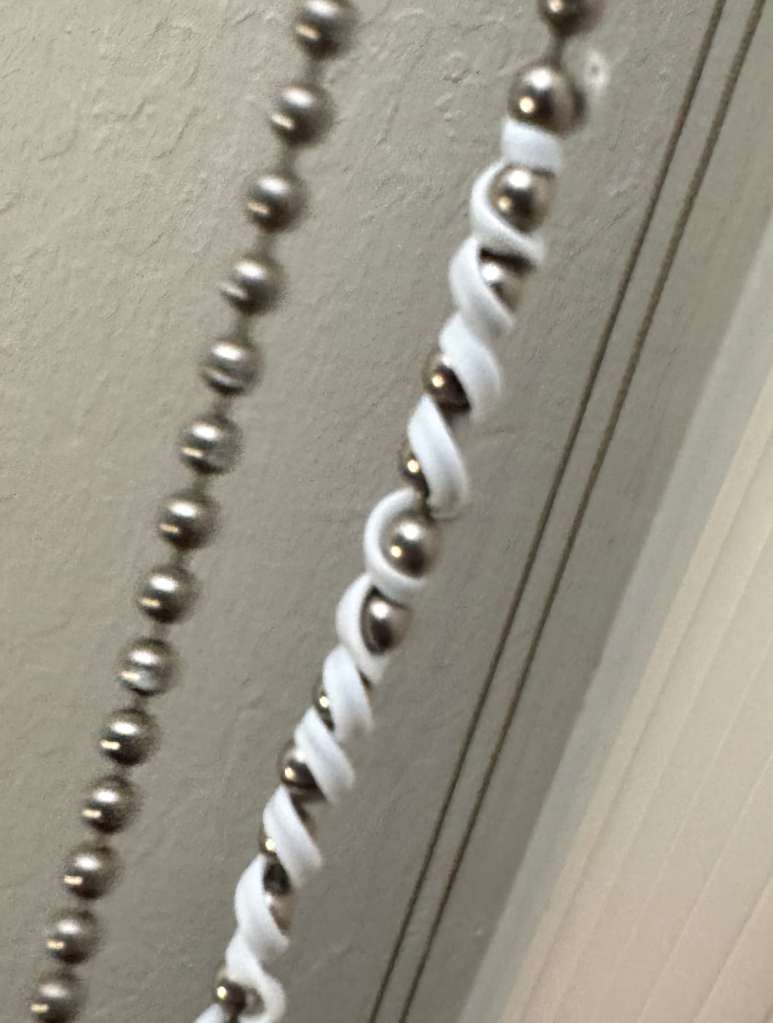
To further reduce ambiguity, two different colors of twist ties could also be used, as shown in Figure 3.

Conclusion:
Vertical blinds should really come straight from the factory with color-coding like this!
PROS: Works perfectly! (A rare “actually tested successfully in real life” Worst Plan.)
CONS: None! You’ll have to be more creative if you want to apply this technique to the fabric cord, though, since twist ties probably won’t stick very well unless you knot the cord or something.
Originally published 2025-06-30.
 WorstPlans: updated every Monday since July 2014!
You must be logged in to post a comment.