
Background:
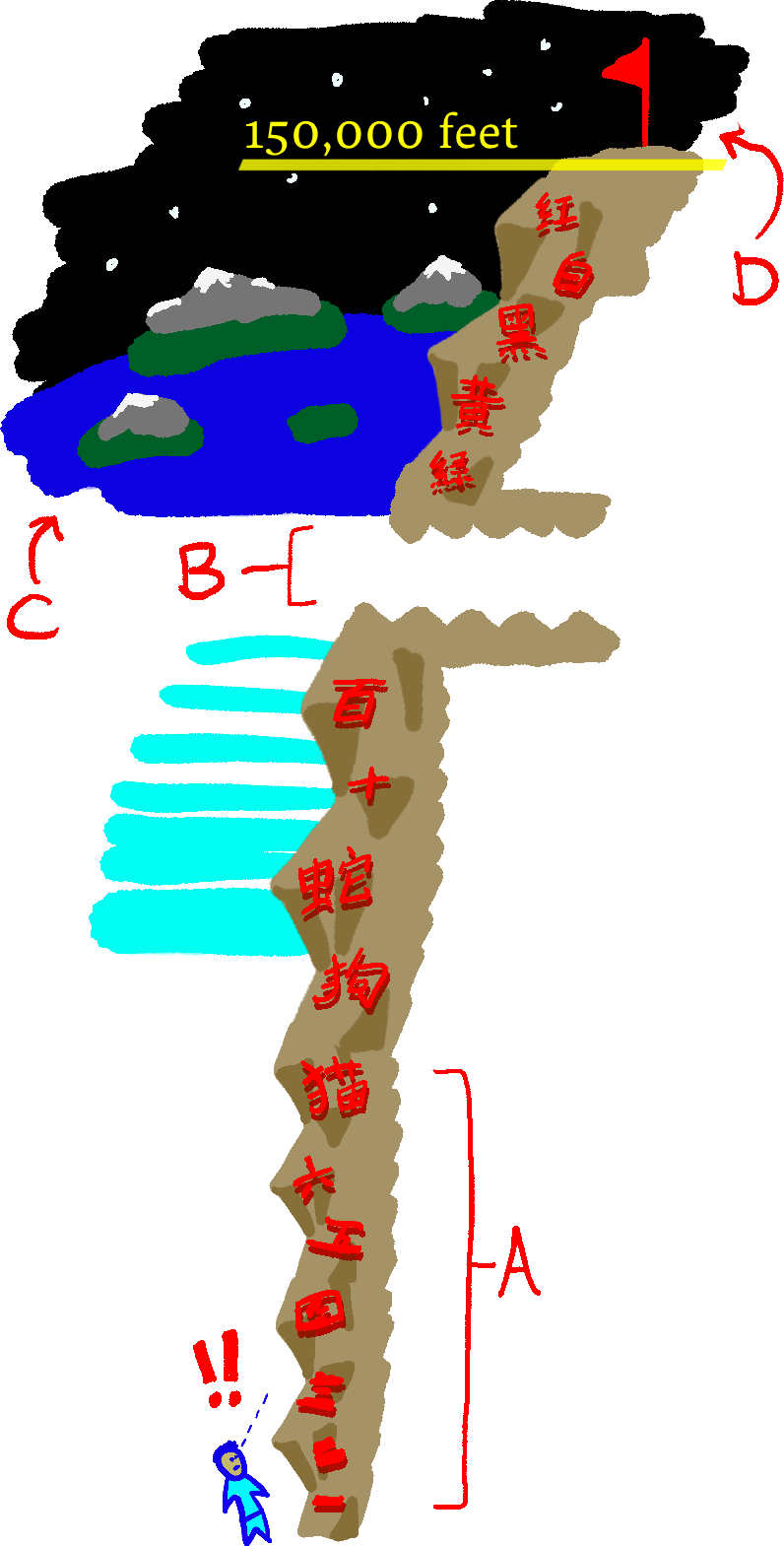
In some climbing gyms, there are introductory climbing walls for children where the climbable hand holds are shaped like a recognizable object (Figure 1), instead of a random-looking piece of stone.

Using the 26-letter (capital letters only) English alphabet, we can assemble a reasonably sized climbing wall wall without using any duplicate letters.
The Issue:
Unfortunately, having only 26 English letters (or 52, if we include lower-case) is unnecessarily limiting.
Sure, we can add a few more by including digits and symbols like the “&,” but there’s still a hard limit on the maximum number of unique holds.
Proposal:
Fortunately, other languages can solve our woes!
Assuming that hold spacing is ~1.5 vertical feet on average, we have the following maximum climbing wall heights for various languages:
- English (upper-case only): 26 glyphs * 1.5 feet/glyph → 39 feet
- English (both cases): 52 glyphs * 1.5 feet/glyph → 78 feet
- Khmer (Cambodian): 74 glyphs → 111 feet
- Tamil: 247 glyphs → 370 feet
This is definitely an improvement, but we might need to look farther afield to really get high-elevation language-themed climbing walls:
- Yi Script (https://en.wikipedia.org/wiki/Yi_script): up to ~1200 unique symbols, depending on how you count → 1800 feet
- Japanese: ~2500 common glyphs → 3750 feet (0.71 miles)
- Chinese (semi-common characters only): ~8000s → 12,000 feet (2.3 miles)
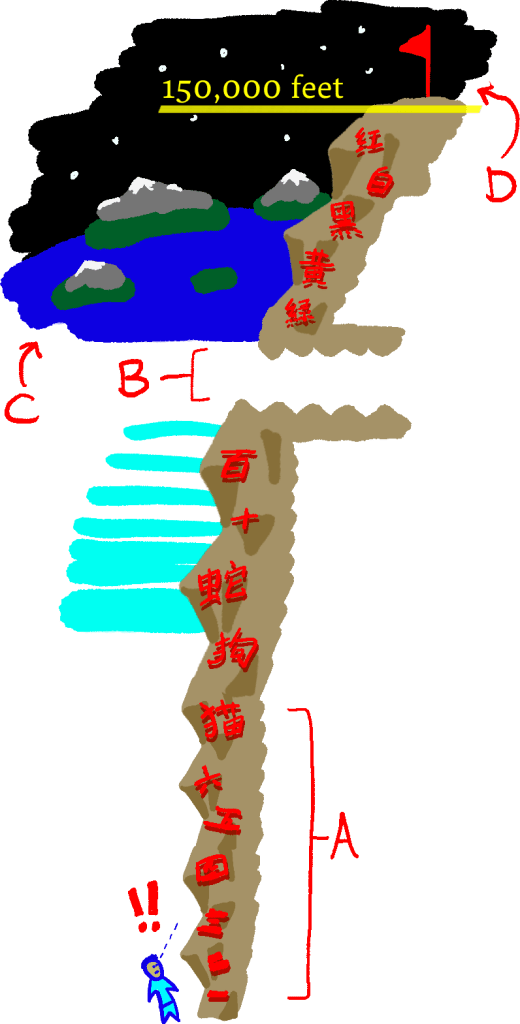
If we want to get really extensive, though, we can use all ~100,000 Chinese characters—mostly extremely rare ones—that are present in Unicode 15.0 (https://en.wikipedia.org/wiki/Chinese_character_sets). This allows us to create the climbing wall depicted in Figure 2:
- Chinese (everything in Unicode 15.0): ~100,000 → 150,000 feet (28 miles, or approximately five Mount Everests)
Conclusion:
This may become the next fad in climbing. You saw it here first!
PROS: Removes any technical limitations that previously existed on climbing walls due to the limitations imposed by the English alphabet.
CONS: A climbing route that passes into a region of the atmosphere with less than 1% of the density required for human survival may be inherently dangerous.
Originally published 2025-06-02.
 WorstPlans: updated every Monday since July 2014!
You must be logged in to post a comment.