
Background:
When arranging furniture in a house, people generally tend to just put tall furniture (bookshelves, wardrobes, etc…) against a wall and just sort of hope that none of it falls over.
Normally, this is a reasonable assumption, except during rare situations such as earthquakes or small children climbing up a bookshelf like a ladder.
The Issue:
Unfortunately, since earthquakes and children both exist, it is possible for otherwise-stable furnishings to come crashing down, laying waste to the countryside (Figure 1).
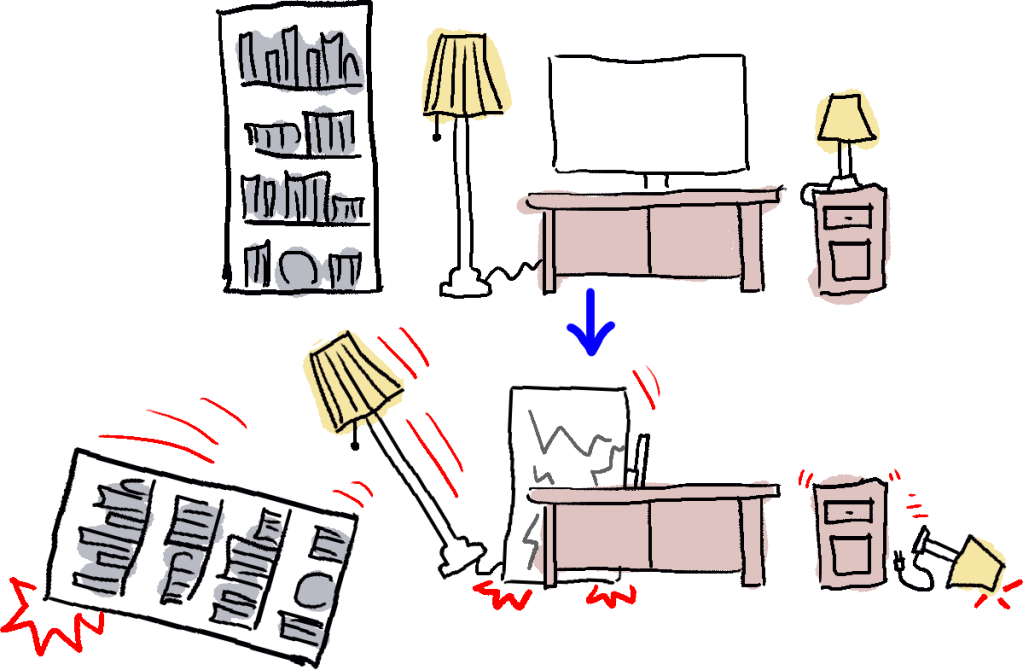
There is simple solution to this: drill an anchor into a wall, then attach the piece of furniture with a short metal wire. However, this process is JUST annoying enough that people often don’t bother to secure their furniture, even in earthquake-prone areas. The attachment wires are also usually quite short (by design), so it means it’s laborious to move furniture around after it’s been attached to the wall.
Proposal:
There’s a rarely-seen interior design element called a a “picture rail moulding” (https://www.google.com/search?q=picture+hanging+wall+moulding): basically, a little “lip” at the top of the wall where you can attach a wire for hanging a picture. (Fancy old houses and art museums use these.) This picture-hanging technology enables a person to non-destructively hang / move art without having to constantly drill and patch holes in the wall.
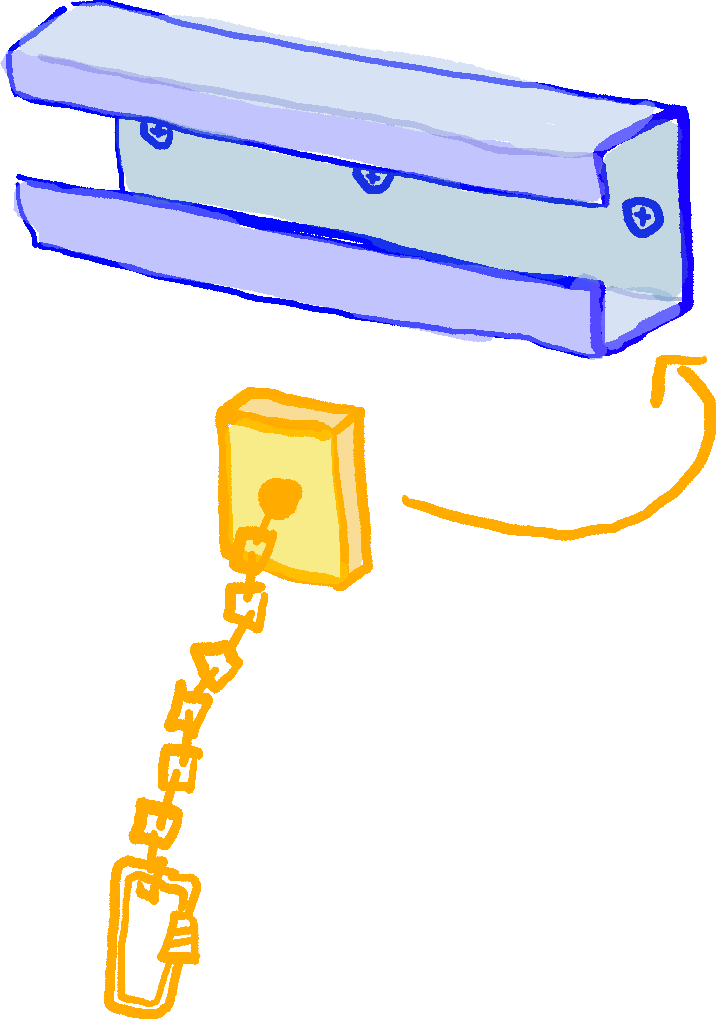
What we need is a similar system for earthquake-proofing! Imagine if every wall had a securely-attached metal rail that furniture could be easily attached to in a clip-on/clip-off manner (Figure 2).

A possible implementation of the furniture-support rail is shown in Figure 3.
Conclusion:
This would greatly increase the likelihood that someone would secure their furniture!
PROS: A good feature to add if you happen to be doing any remodeling in a region of the world where earthquakes or children exist.
CONS: Might be difficult to come up with an aesthetically-tolerable version of this highly industrial metal rail system. Or would it be? Maybe it would be easy! Someone should give it a try, anyway.
Originally published 2025-03-17.
 WorstPlans: updated every Monday since July 2014!
You must be logged in to post a comment.