

Background:
In smaller homes and apartments, it is likely that most rooms are multi-purpose: a “dining room” might also include a sofa and TV, and a “bedroom” might host an artist’s easel, work desk, yoga mat, exercise bike, and more.
This is a practical method of using limited space, but people often find it unpleasant to have all of their worldly possessions crammed into a small space.
The Issue:
The only way to solve this issue in the past has been to pay for a larger (possibly unnecessarily large!) living space—but this can be incredibly expensive!
Proposal:
Fortunately, thanks to the power of virtual reality (“VR”), it’s possible to repurpose the same physical space for multiple things while still providing the illusion of a spacious non-cramped home.
Let’s consider a hypothetical one-bedroom apartment (Figure 1):
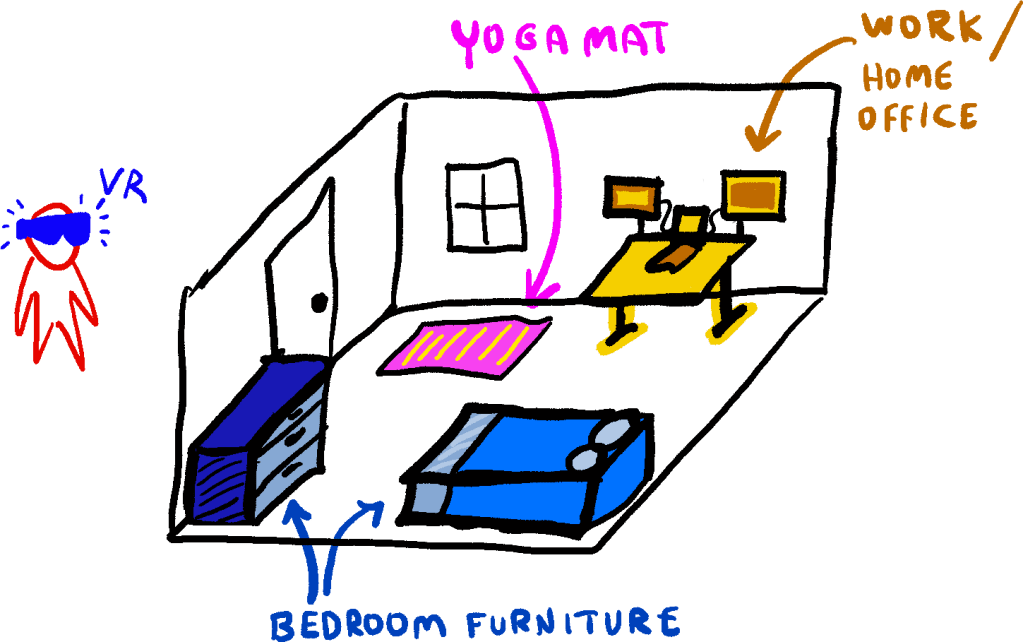
The physical space above can be divided into three distinct and mutually-exclusive functional areas:
- A “bedroom” space (blue)
- A “yoga / exercise” space (magenta)
- A “work / home office” space (yellow)
In a world of infinite resources, the person in Figure 1 would probably want three separate rooms. But since that would require a huge rent increase, we must consider the next best thing: three separate virtual rooms.
In this system, the user wears a VR headset that displays an edited version of the bedroom that has been modified to suit a particular task (Figure 2).

When the user wants to go from their “bedroom” to their “home office,” they simply exit the bedroom, press a (virtual) button on the wall (as if they are calling an elevator), and re-enter the bedroom, which will now appear as a “home office”.
(It would also be possible to have the the rooms be connected with “portals” in a non-euclidean fashion: the user would just walk around their room in a particular fashion, and it would appear to them that they were walking between room that just happened to share the same physical space. This might be more confusing than the “elevator button” approach, however.)
Conclusion:
This system allows the user to get three (or perhaps even more!) rooms out of just one real room!
PROS: Get a “luxury mansion” experience for the price of a modest one-bedroom apartment.
CONS: Requires wearing a VR headset all the time.
Originally published 2024-07-22.
 WorstPlans: updated every Monday since July 2014!
You must be logged in to post a comment.