
The Issue:
Many movies feature a protagonist who the audience sympathizes with, despite the fact that in real life, that same audience might disapprove of such a person.
There’s a lack of ethical consistency here. Why would a moviegoer root for an amoral assassin in a movie (e.g., in Day of the Jackal), yet support imprisonment or execution for such a person in real life?
Proposal:
We will solve this ethical-inconsistency issue by adding a “Choose Your Own Adventure™” quality to fiction.
Let’s consider how this would work in the “pig protagonist” genre (which includes the movie Babe (1995) and the 1952 book Charlotte’s Web). The audience generally hopes that the pig will NOT get eaten, despite the fact that (1) that is the purpose of a pig on a farm and (2) those same audience members may watch the movie and then immediately go out to eat a bacon cheeseburger.
A pig-protagonist movie would start with a quiz that asks the viewer to indicate what a good breakfast dish should look like (Figure 1).

If the user selects one of the two pork dishes in Figure 1, then at the end of the movie, the pig is (regrettably) slaughtered to make that specific dish, which is then presented directly to the viewer in the final scene of the movie.
Children would undoubtedly be excited by this interactive element!
A similar quiz could be applied for movies that involve people fleeing across borders at some point in the plot, such as The Sound of Music (1965), Fiddler on the Roof (1971), or Three Kings (1999).
For movies in this genre, viewers could be presented with the image shown in Figure 2 and asked if the people in the image should be:
- Option 1: turned away and returned to their home country, or
- Option 2: allowed to remain while a (potentially expensive and time-consuming) bureaucratic asylum process takes place.
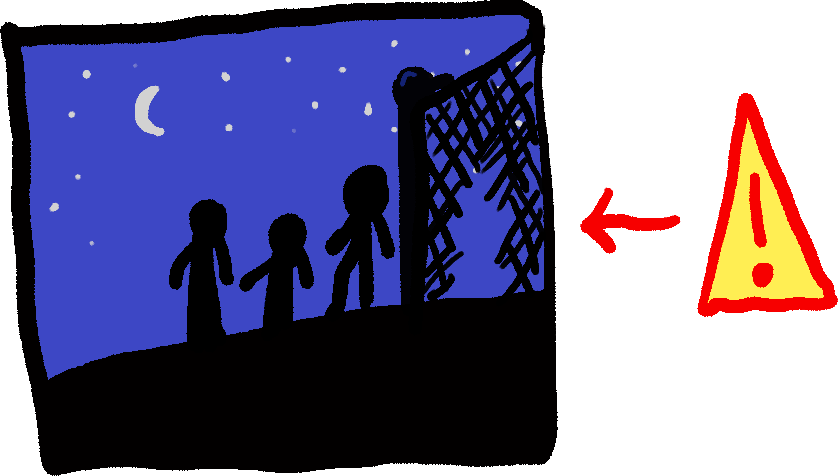
A viewer who answers Option 2 would see the traditional ending of The Sound of Music, while viewers selecting Option 1 could see an updated version in which the Von Trapp family is immediately turned over to the Nazi authorities.
Economic Practicality:
It might be hard to justify the cost of filming multiple endings. Luckily, there are rare cases in which a movie already had alternate endings filmed!
For example, the first Rambo film (“First Blood,” 1982) has two versions: one where Rambo survives, and one where he dies. (Since there are four sequels, you can probably guess which one is the “canonical” ending.)
In the Rambo example, the quiz at the beginning of the movie could be something like: “If an out-of-towner enters a town and engages in violent conflict with law enforcement, eventually leading to the death of a police officer, should (Option 1) the local police fight back, and the only way out for this troublemaker is death, or (Option 2) should he be brought to trial, following due process of the law?” (Option 2 would show the “standard” ending.)
Shorter Versions of Films with non-standard endings:
It would also be possible to have non-standard endings at various points in a film. For example, a certain famous 1999 Keanu Reeves movie could start with the quiz “Would it be preferable to continue to live in a pleasant dream world, or to wake up and discover that the real world is in ruins?” If the audience answers ”dream” world, then the movie ends at the “red pill / blue pill” scene, creating an alternate ~40 minute version of the film.
PROS: This would be a great way to get people talking about a movie and make them more emotionally engaged
CONS: There might be a VERY SLIGHT amount of trauma inflicted on children who pick the “yes, I would like to eat a tuna sandwich” option at the beginning of an updated version of Finding Nemo, but they’ll probably eventually get over it in a few decades.
Originally published 2026-06-08.


You must be logged in to post a comment.