Background:
Sometimes, classic art intentionally evokes a negative emotion. Here are some classic examples:
- https://en.wikipedia.org/wiki/Saturn_Devouring_His_Son
- https://en.wikipedia.org/wiki/Ivan_the_Terrible_and_His_Son_Ivan
- https://en.wikipedia.org/wiki/The_Scream
The Issue:
However, perhaps the world is already cruel enough, and humans don’t need to be subjected to further psychological trauma.
But how can we continue to enjoy classic art while simultaneously making sure our fragile emotional state is coddled at all times?
Proposal:
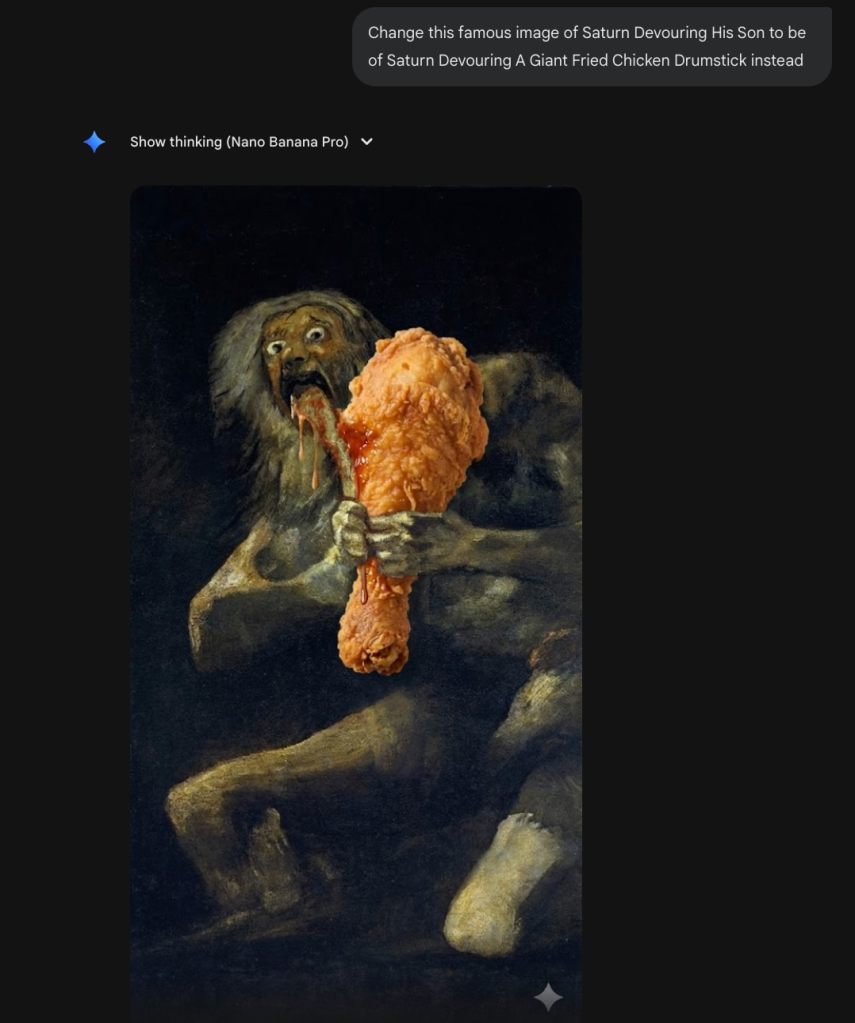
AI to the rescue! First, let’s examine a piece of art that might be psychologically upsetting (Figure 1):

With the power of AI (in this case, Google Gemini), maybe we can improve the scene in Figure 1 to make it more fun and less traumatizing. The results speak for themselves (Figure 2)!

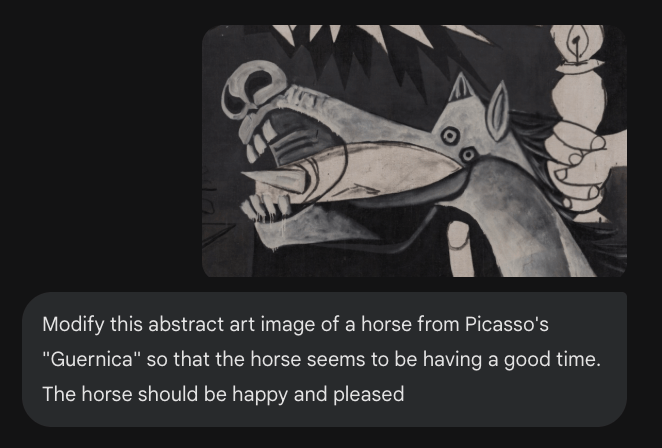
Likewise, the horrors of war depicted in Picasso’s Guernica (https://en.wikipedia.org/wiki/Guernica_(Picasso)) are intentionally disturbing (Figure 3).
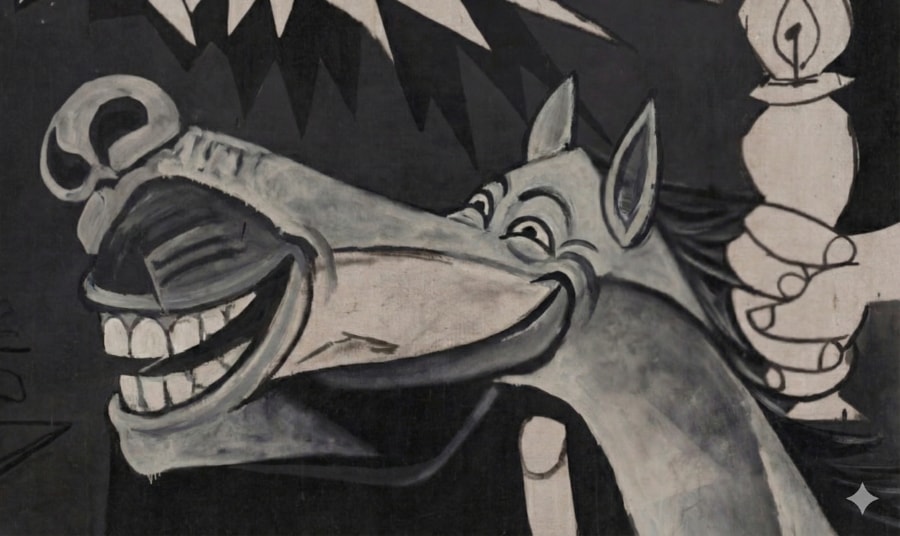
But once again we’re able to easily revise the artwork so that the horse is having a great time (Figure 4):
Conclusion:
Modifying classic art to avoid even the slighting hint of discomfort in the viewer is now not only possible, but easy!
PROS: Improves the psychological state of visitors to art museums.
CONS: None, art historians will probably love it too.
Originally published 2025-12-22.
 WorstPlans: updated every Monday since July 2014!
You must be logged in to post a comment.