
Background:
Textbook publishers will often issue a new edition of a textbook every few years.
Sometimes, this is necessary to reflects new developments in the field, but for many topics, the field has been static for hundreds (or possibly even thousands) of years.
For example, it is unlikely that the 15th edition of an “Introduction to College Algebra” textbook is meaningfully different from the 16th edition, unless, I don’t know, someone discovered that y does not actually equal mx + b or whatever.
(Incidentally, it’s not uncommon for textbooks to actually reach double-digit edition numbers: https://www.google.com/search?q=textbook+17th+edition).
Another reason for a textbook to be updated is simply to force students to buy copies of the new edition, rather than cheaper used copies of the old edition that are presumably still floating around on the used market.
The Issue:
Unfortunately, savvy teachers will sometimes realize that very little has changed between editions, and will simply mention that, for example, “the page numbers are different between editions, but the chapters are the same: so everyone should still reach chapter 3, regardless of their textbook edition.”
As a result, cash-strapped students may still be able to use older (i.e. cheaper) editions of a textbook.
Proposal:
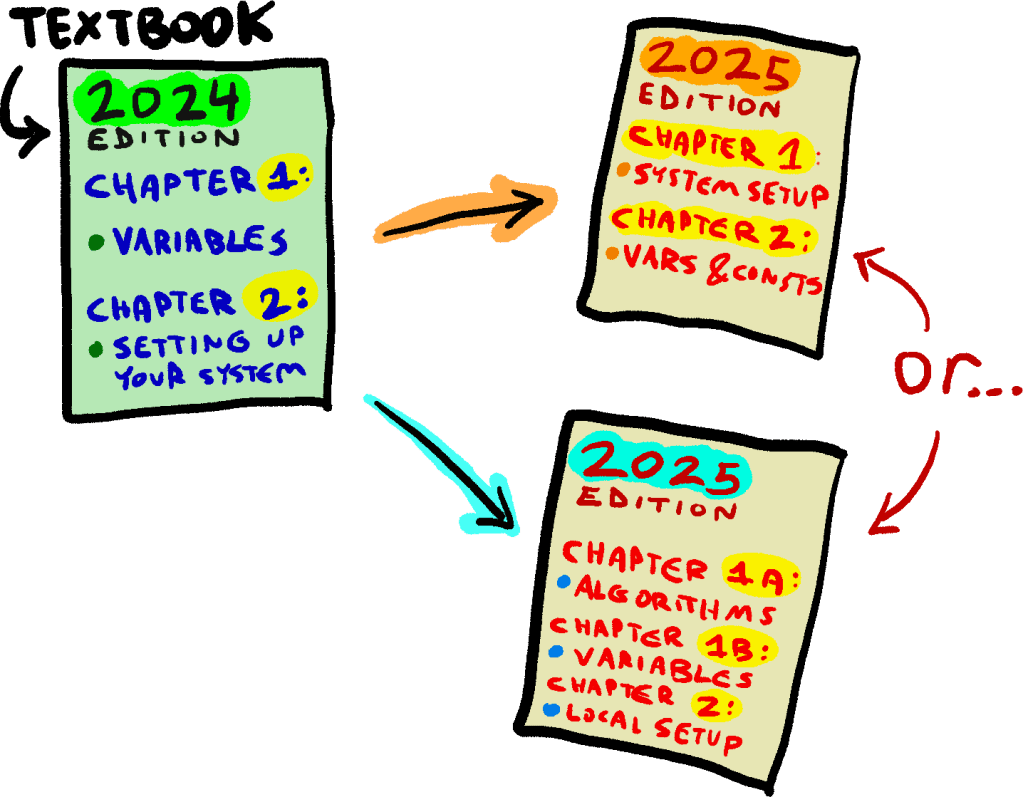
To solve this problem and prevent these penny-pinching students from learning, we can design a system such that every new edition of a textbook is substantially restructured, with all the chapters moving around, chapter titles changing, and some content moving between chapters.
As shown in Figure 1, this reworking could be done at a very high level. Just moving the chapters around might be enough to make it extremely annoying for students to use an “incompatible” / non-current version of a textbook, thus forcing them to buy the current edition.
Technical Details:
The implementation of this “textbook auto-rewriting” process has become much easier thanks to state-of-the-art AI.
Previously, automatically re-ordering chapters and contents would have required time-consuming manual annotation of the contents of the textbook (e.g. “this sub-chapter could fit into Chapter 4 part 2 or Chapter 5 part 3 or part 4”).
But now, we can just paste the old edition of a textbook into an LLM and give it the prompt <You are a computer who hates students: rework this textbook to move all the chapters around. Try to make NONE of the chapters in the same order as before, but try not to make it ultra-confusing>.
Then, a couple minutes later, we’ll have a new same-content-but-incompatible-organization edition of the textbook!
PROS: Punishes students for trying to learn without paying the price!!!
CONS: Theoretically, teachers might switch away from these user-unfriendly textbooks, since it would be very annoying from a teaching perspective to have all the textbook contents move around every year. That’s why it’s important for governments and universities to mandate specific textbooks.
Originally published 2025-11-24.
 WorstPlans: updated every Monday since July 2014!
You must be logged in to post a comment.