
Background:
Some acronyms already include the “name” of the noun in the acronym: for example, an “ATM” [*] (automatic teller machine) or “PIN” (personal identification number).
But for the sake of clarity (and maybe because it sounds more natural in some cases), people will often say “ATM machine” or “PIN number.”
[*] Yes, yes, “A.T.M.” is technically an initialism (rather than an “acronym”) since you pronounce each letter separately, rather than trying to say it as a word (which would, I guess, sound like “atum”).
The Issue:
If you have any annoying coworkers, friends, or relatives, they may correct your use of “ATM machine” by saying “oh, you’re going to the automatic teller MACHINE MACHINE, what is that?”
Amazingly, this phenomenon has its own Wikipedia page, jokily named “RAS syndrome,” or “redundant acronym syndrome… syndrome” (https://en.wikipedia.org/wiki/RAS_syndrome).
Proposal:
To solve this problem, we need to create alternative versions of each of these acronyms, so that “ATM” and “ATM machine” both make sense when you ”expand” out the acronym.
Some example sentences:
- “I’m going to the ATM (automated teller machine) machine”
- “The enemy launched a SAM (surface-to-air missile) missile at our jet”
- “Please enter your PIN (personal identification number) number”
- “Don’t give out your SSN (Social Security number) number”
- “Convert the file to PDF (portable document format) format”
- “You’ll need your car’s VIN (vehicle identification number) number”
Although pedantic correction of one’s verbiage is usually not a big deal, it could theoretically have disastrous consequences, as shown in Figure 1.
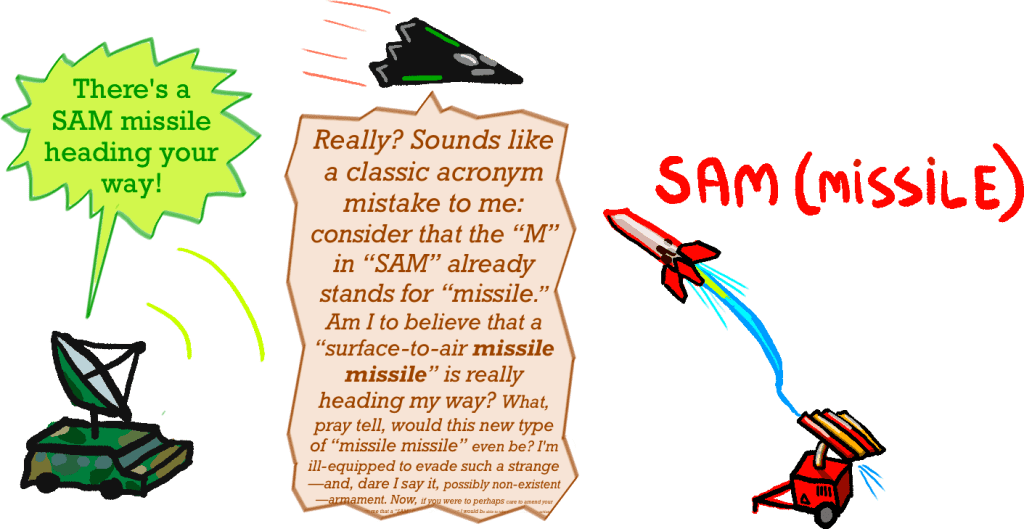
To fix this situation, we just need to give each acronym an alternate meaning so that the sentence still “makes sense” even with the acronym expanded:
With the fixes in place:
- “I’m going to the ATM (automated teller money) machine”
- This more accurately indicates the purpose of the ATM.
- “Please enter your PIN (personal identification needs-to-be-secret) number”
- This change additionally indicates the importance of not sharing this number.
- “The enemy launched a SAM (surface-to-air-mostly) missile at our jet”
- A surface-to-air missile could technically be launched into a nearby tree or down into a canyon, so it’s only a “surface-to-air MOSTLY missile.”
- “Don’t give out your SSN (Social Security numeric) number”
- Social security numbers are guaranteed to be numeric, so this remains accurate.
- “Convert the file to PDF (portable document frustration) format”
- This accurately reflects the difficulty of editing this file format without introducing additional undesired formatting changes or paying Adobe for an Acrobat license.
- “You’ll need your car’s VIN (vehicle identification note) number”
- VIN “numbers” also include letters, so “VIN” was not strictly accurate to begin with. We’ll call this thing a “note” since it’s sort of like the factory was leaving a bunch of “notes” on the various pieces of a car to indicate which car they were for.
Conclusion:
Should reduce misunderstandings and provide one less (or one fewer) thing for someone to be annoyingly pedantic about!
PROS: Brings peace to the land.
CONS: None!
Originally published 2025-11-10.
 WorstPlans: updated every Monday since July 2014!
You must be logged in to post a comment.