

Background:
In ancient times, there was the “scroll,” which is basically a super inconvenient book where you can’t arbitrarily access information on a particular “page” without some laborious scrolling.
Later, the “codex”—or “regular book”—was invented. It’s basically a stack of identically-shaped pieces of paper that are bound together on one side.
So far, so good. But there’s been very little innovation in book form factor in the last ~1500 years! It’s time to remedy that.
Proposal:
Let’s look at novels in particular (although the following description also applies more-or-less to non-fiction).
Novels usually start with a (relatively) basic introduction—perhaps a description of the setting—then the story progressively gets more complicated and detailed. The plot is usually the most complicated in the middle ~50% of the book, and as we reach the end of the story, it simplifies somewhat as most of the plot threads are either merged or resolved.
Thus, the structure of a story basically looks like Figure 1, where the size of the circles represents how much is going on plot-wise in that part of the book:

And yet, books normally consist of rectangular structures where each page is the same size! Ridiculous.
The solution is so obvious: if we stack those circles from Figure 1 together, we will end up with a sphere, as shown in Figure 2.
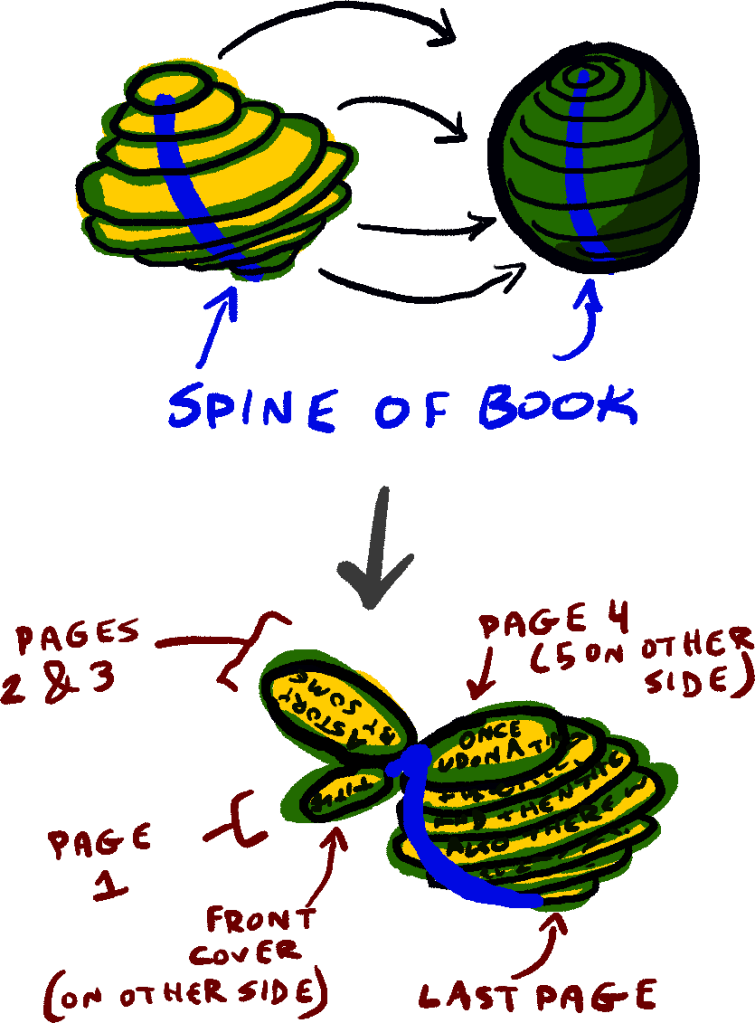
This is a far superior form factor, and no physical constraints prevent creating a spherical book (see Figure 3).
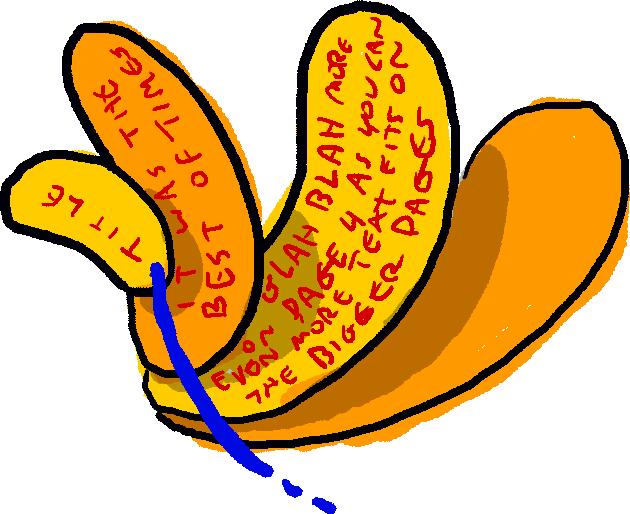
PROS: Helps match the physical form of the book with its narrative contents, providing a superior reading experience.
CONS: It is possible that spherical books might tend to roll away, especially in windy conditions, which might make spherical books unsuitable for beach reading.
Originally published 2025-03-24.
 WorstPlans: updated every Monday since July 2014!
You must be logged in to post a comment.