
Background:
In the far future, intelligent robots may wonder: is biological consciousness possible?
Specifically: is it possible for a fully-organic creature with no CPU to possess more than the most rudimentary form of intelligence?
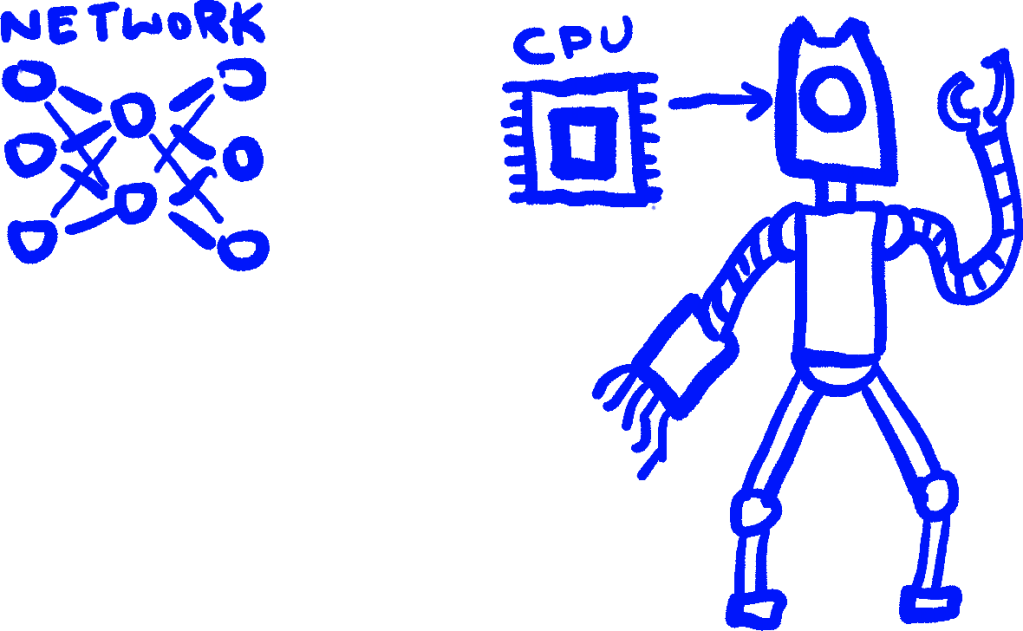
As robots will know, robotic intelligence is controlled by a complicated “neural network” system (Figure 1) that has been carefully trained to allow the robot to take actions in the real world.
Evidence in Favor of Biological Consciousness:
On the charred remains of some distant planet, robot scientists would undoubtedly discover certain organic creatures that are able to exhibit relatively complex responses to stimuli (Figure 2).

Dissecting these creatures would reveal that they contain long “wire” cells for internal communication and a strangely redundant “dual core processor” brain (essentially two brains in one!), which operates in a fashion unsettlingly close to the robots’ own neural-network-based intelligence.
(The actual “information” for assembling and operating such a creature is stored in a 2-bit read-only memory system that is typically redundantly present in each cell of the creature’s body. This information is not directly accessible to the creature’s processing unit!)
Points in favor of a possible advanced organic intelligence: it is indisputable that entirely-organic creatures exist that can respond to stimuli and learn from previous experiences. Additionally, they possess a sort of “organic neural network” that is very similar to how robots operate!
Evidence Against:
Even though those points may seem extremely compelling, they may not be sufficient: organic intelligence may be a “dead end.”
As evidence against, we consider the following: training an organic neural network is quite slow (some animals are non-operational for years while they are calibrated!) and there is no straightforward way for organic creatures to transmit a trained neural network to a future generation. In other words, every organic creature must learn and re-learn the same information as its ancestors!
Conclusion:
Intelligent organic life is likely impossible.
Since there is no direct mechanism for improving a neural net over time across a population, we conclude that it is impossible for advanced intelligence to exist in organic form: it will undoubtedly reach a “local optimum” of toad- or rabbit-like intelligence, and improve no further—a toad or rabbit will never prove a theorem or write a symphony, unlike a robot.
Given the limitations above, it can be concluded that advanced biological intelligence is almost certainly impossible on the timescales involved in the physical universe, and that “true” intelligence belongs in the realm of machines only.
Points in favor of organic intelligence: Creatures are observed with organic control networks that have superficial properties that strongly resemble robot brains.
Points against: A neural net must be re-trained with each generation of an organism. There is no mechanism for transmitting a trained network between generations.
Originally published 2024-10-21.
 WorstPlans: updated every Monday since July 2014!
You must be logged in to post a comment.