
Background:
Making coffee can involve a number of steps (Figure 1). In an effort to streamline this process, many alternative coffee-making approaches have been devised.

Among the “simpler” approaches to making coffee include instant coffee (“just add water”) and the often-ridiculed (yet commercially successful) coffee “pod” system (Figure 2).
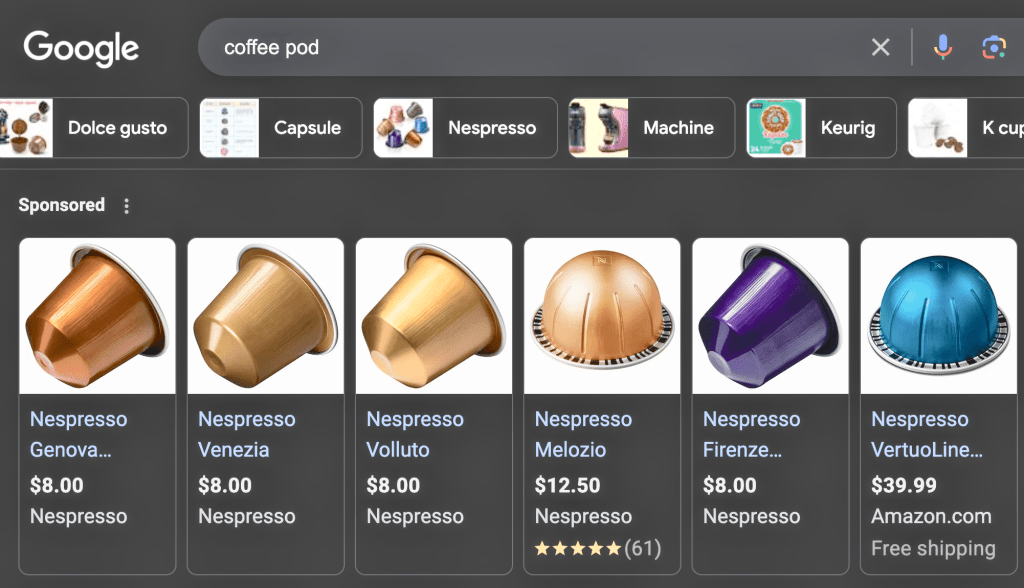
The coffee pod machine (Figure 3) has been optimized to be minimally labor intensive. Some pods even include cream, so these machines are able to make a plausible latte at the push of a button.

Fig. 3: It seems like the coffee-making process has already been made as brutally efficient as possible… or has it???
Proposal:
A person might think that the coffee pod system shown above is the ultimate apex of streamlined efficiency. However: this is not true—consider that the coffee grinding and pre-processing must have still occurred earlier in the preparation process (even if this is invisible to the user).
Let us consider the minimal elements of the coffee-making-and-drinking experience:
- 1. Take coffee beans as input (we will assume these were already roasted).
- 2. Brew a coffee.
- 3. Drink the coffee.
The coffee pod machine above really only handles step 2!
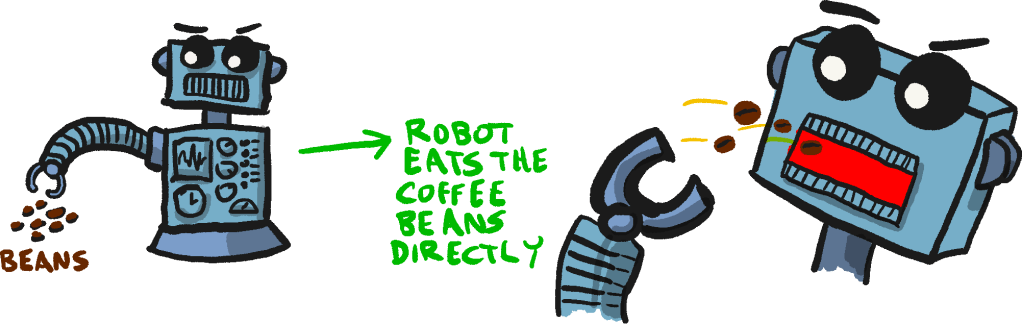
To fully optimize the system, we must design a robot that will handle steps 1 and 3. Behold, the fully-automated end-to-end coffee handling system shown in Figure 4!
Conclusion:
This system cuts out all the previous superfluous tasks involved in the coffee-preparation-and-drinking ritual. It should be an especially huge time-saver in France and Italy!
PROS: Should increase labor productivity. Frees up a substantial amount of time that was previously wasted in coffee-related tasks.
CONS: One might ask, well, if the robot just eats the coffee, why do we still order coffee? What even is the point of this robot? To which I retort (smugly): what is the point of anything???
Originally published 2024-07-29.
 WorstPlans: updated every Monday since July 2014!
You must be logged in to post a comment.