
Background:
Home ownership is frequently promoted as a “can’t lose” investment that always increases in value.
The Issue:
Unfortunately, it’s difficult—some might even say mathematically impossible—for housing to always increase in value, which means that some people will have bought housing and not reaped returns from it.
It’s possible to increase housing values by improving a city in some way, but this is a difficult process. Thus, we must ask: is there some way we can increase the average value of housing in a city without improving the city?
Proposal:
Some creative ideas have already been tried: for example, California amended its constitution[*] so that property tax doesn’t meaningfully increase even if surrounding property becomes more expensive.
[*] https://en.wikipedia.org/wiki/1978_California_Proposition_13
(This even works for inheritance: if you’re lucky enough to inherit property that was vacant farmland in 1978, you can—50 years later—still be paying the same “vacant farmland” property tax for a valuable property in the middle of a city!)
This doesn’t fully address the issue, however, so let’s step back and solve this “increase property values” issue from first principles.
Item 1: we note that property values are highly variable across a city (Figure 1).

Item 2: mathematically speaking, an average value can be raised by removing the lowest values.
Thus, a plan reveals itself: every few months, just bulldoze the city block with the lowest average property value (Figure 2), and the average value of the remaining property will increase*!
[*] Assuming it doesn’t change as a result of the bulldozing.
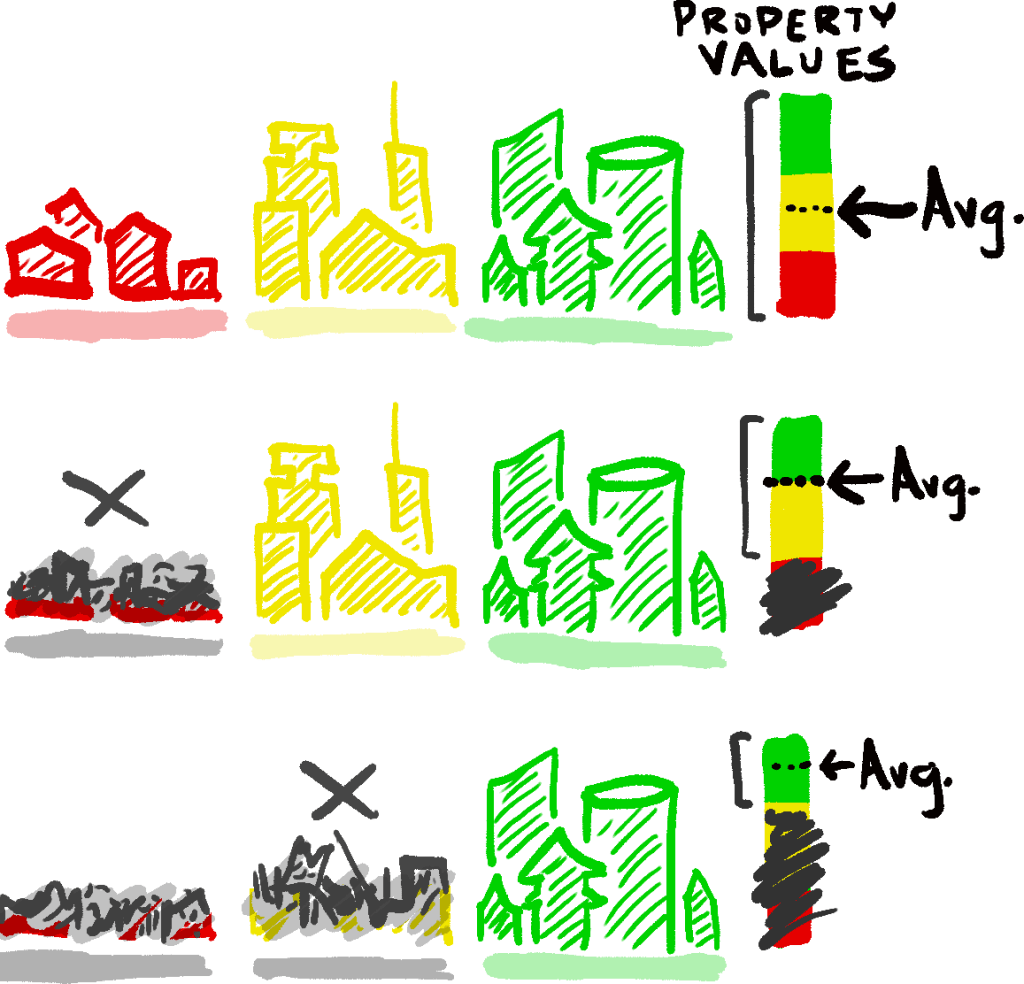
This process can be repeated as long as at least one structure still remains.
PROS: These accomplishments will look great on a resume (“During my 4 years as mayor, the average housing value went up from $450,000 to $900,000, and we demolished over 80% of the city!”)
CONS: Care must be taken to not accidentally bulldoze the very last building in the city, as division by zero is an undefined operation, and it is unclear what the average property value would look like if such a mistake is made.
 WorstPlans: updated every Monday since July 2014!
You must be logged in to post a comment.