
Background:
Some e-reader devices are backlit, which allows a user to read the text of a book even in a low-light situation.
The Issue:
Unfortunately, traditional physical books never have a backlight, due to being made of the notoriously non-luminous substance “paper.” So for a regular book, a user is reliant on overhead lighting.
Proposal:
Why don’t we bring the power of backlighting to regular physical books? In fact, we don’t even need a new type of electronic device for this: all we need is an illuminated rectangle (like a tablet or e-reader showing a blank page) that can be slotted behind a printed page.
There’s only one problem, as shown in Figure 1:
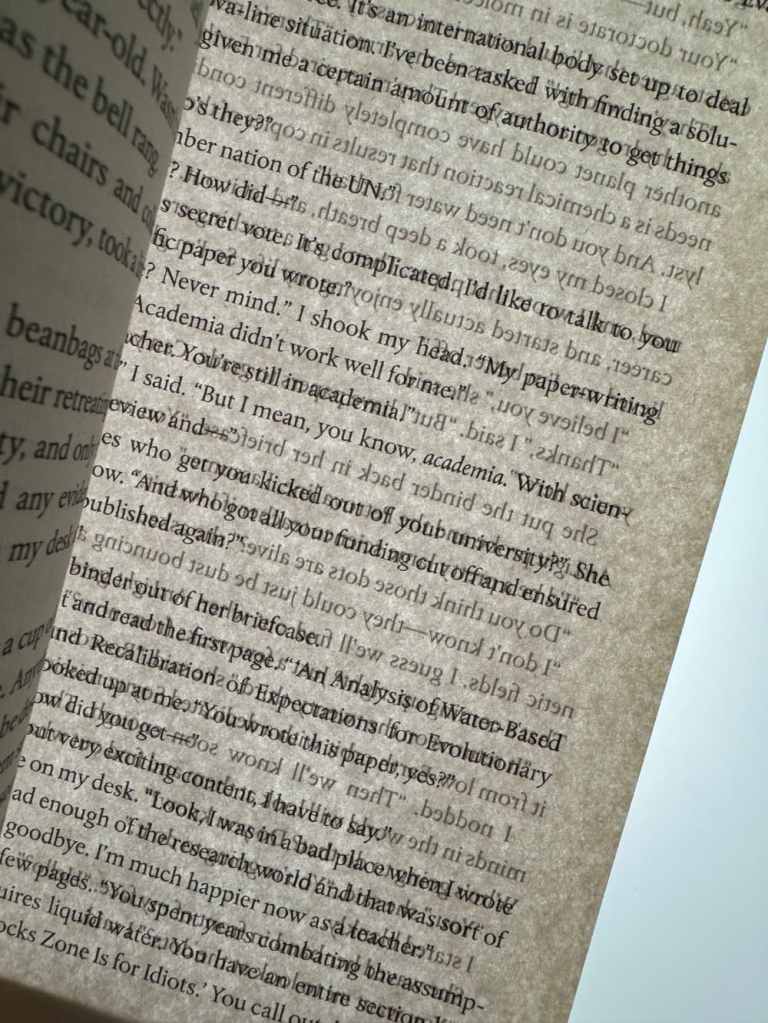
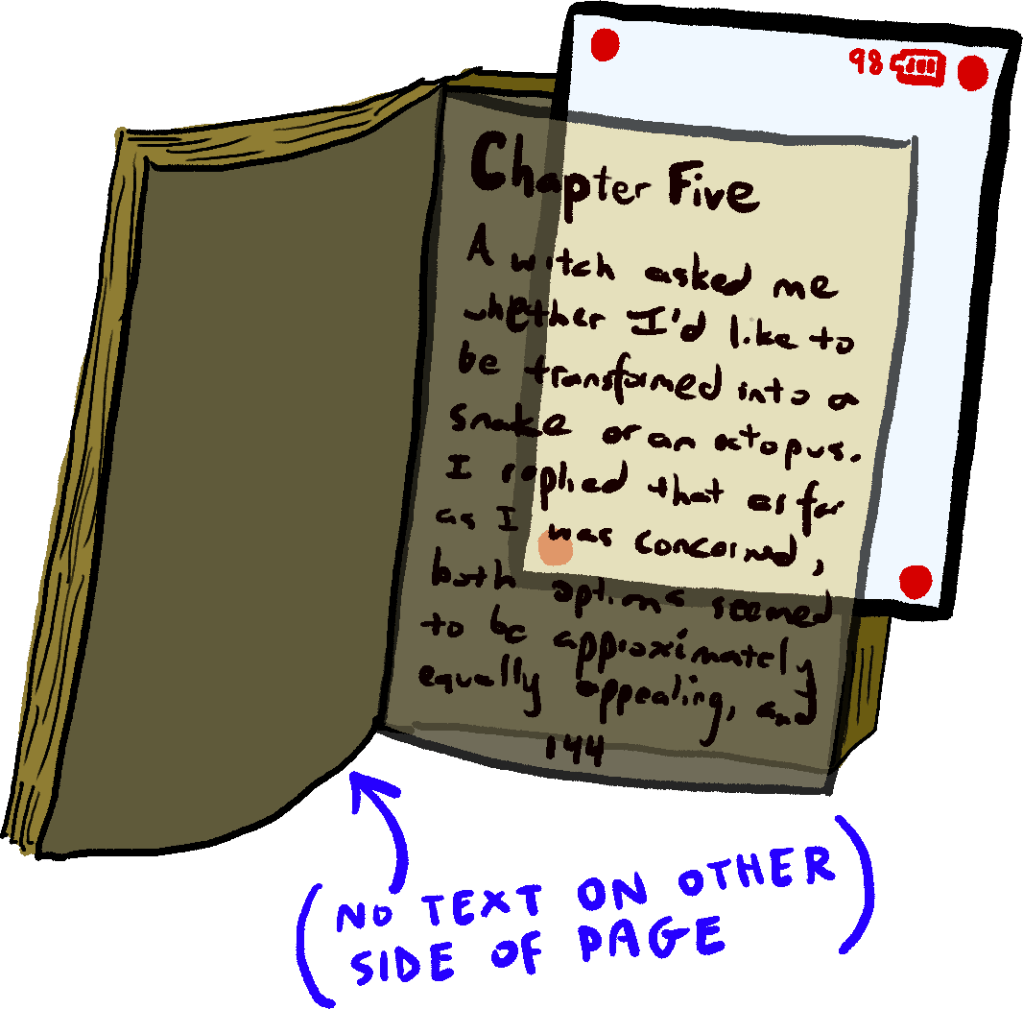
Fortunately, we can solve this by printing special “backlight compatible” versions of books (similar to large-print or braille versions). These would just be regular physical books where each page only has text on a single side, thus making them “compatible” with a backlight (Figure 2).
Conclusion:
Works flawlessly, and requires no new technology!
PROS: Due to the increased page count, this type of book could increase the profit margins in the publication and paper-manufacturing industry.
CONS: Doubling the number of pages in each book could be annoying, especially for particularly long series. If someone wanted to read “The Wheel of Time” printed in this fashion, they’d need a forklift to move their books around.
Originally published 2026-01-05.
 WorstPlans: updated every Monday since July 2014!
You must be logged in to post a comment.