
Background:
Some people are never on time to events. It is frequently recommended that these people intentionally set their clocks ahead (by, say, 15 minutes). In this way, even if a person leaves “late” (by their own clock’s reckoning), it is actually still “on time” in the rest of the world.
The Issue:
Unfortunately, it’s hard to specifically set a clock ahead the exact right amount. Plus, a person who sets their clock ahead will probably eventually get used to it and recalibrate their lateness, thus becoming a late-arriver again.
Proposal:
What is needed is a “smart” clock that can intelligently adjust the time ahead—but only when it’s actually important to do so. Specifically:
- By default, the clock just displays the time normally.
- The clock integrates with the owner’s calendar to see when important events are coming up.
- When an important event is coming up, the clock adjusts itself forward to motivate the user to leave slightly earlier (Figure 1).

For example, if the clock owner is habitually 20 minutes late to work, the clock will surreptitiously set itself ahead by 20 minutes. This will, hopefully, cause the clock’s owner to leave for work 20 minutes earlier (and thus arrive on time).
Or, if the owner has an upcoming airline flight, the clock might set itself an entire hour ahead to make sure the person makes it to their flight.
The clock could also obtain the owner’s GPS coordinates from their phone to check the validity of its time-setting estimates. If the owner is still late, the clock needs to continue to set its fake time forward. Conversely, if the owner starts arriving to events early, the clock can (slightly) move its fake time back closer to the actual time.
There is some complexity involved in this system, as multiple clocks would, ideally, all be in on the scheme to set a fake time (Figure 2).
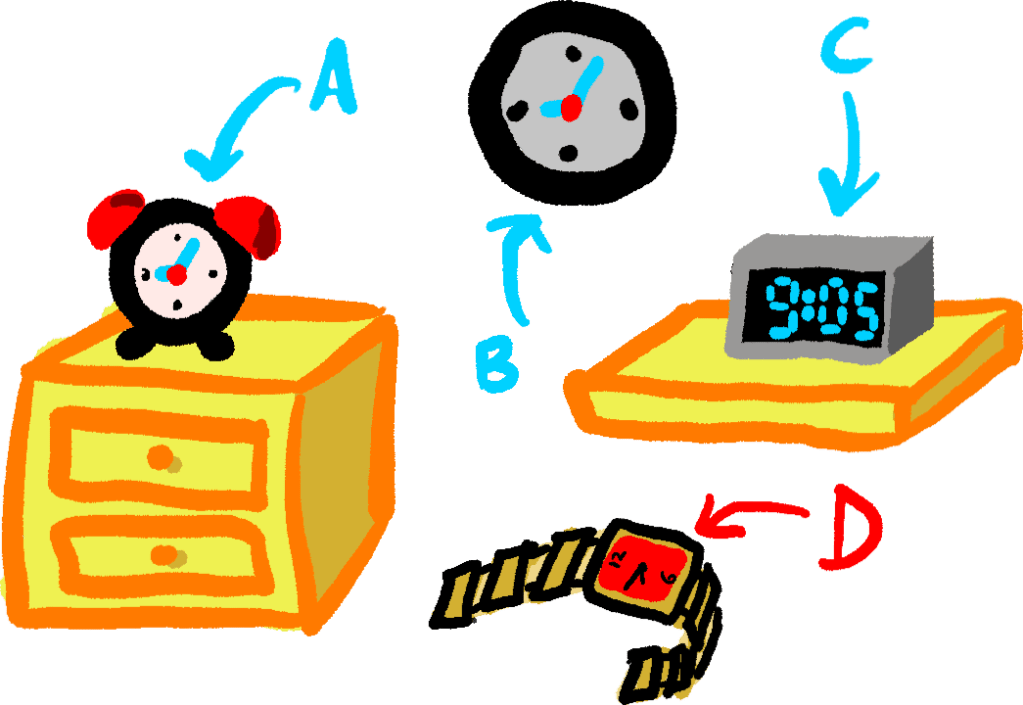
Although it might be infeasible to get all of these devices to talk to each other, it’s likely that 90% of the effect could be achieved by just getting a person’s phone and watch to operate on “smart” time.
PROS: Could be beneficial to everyone!
CONS: Since almost everything has a clock in it, there are a lot of devices (e.g. stove, microwave, automobile) that would need to conspire in order for this scheme to be fully convincing.
Originally published 2025-02-24.
 WorstPlans: updated every Monday since July 2014!
You must be logged in to post a comment.