Background:
Frequently, products that are offered in multiple languages find that they would like to use an icon to represent the language. For example, a tourist destination might have a French flag to indicate tours in French, and a German flag to indicate tours in German.
The Issue:
It’s understandable that people want each language to have an icon: an icon is more eye-catching than plain text, and all languages can be represented by an icon of the exact same size.
Unfortunately, although this usually works in practice, it has some annoying downsides!
Sometimes the flag choice is easy and intuitive: for example: Japanese language → Japanese flag (🇯🇵). Easy?
But suppose you translated a video game to Portuguese. Do you use the flag of Portugal (🇵🇹) or Brazil (🇧🇷)?
For English, you sometimes see a web site indicate “English” withboth the U.K. flag (🇬🇧) and U.S. flag (🇺🇸).
But if a web site wanted to be more comprehensive, perhaps it should add Australia (🇦🇺), too. And Ireland (🇮🇪)? New Zealand (🇳🇿)? Liberia (🇱🇷)? India (🇮🇳)? South Africa (🇿🇦)? This collection of flags is becoming unwieldy, and we still have dozens more to add. (Note that there is in fact a flag for just England (🏴), but it’s surprisingly uncommon to see it used to represent “the English language”).
So that’s the first problem: there might be no unambiguous “this is the only possible choice of a flag for this language” option (Figure 1).

The second problem: Some countries have similar looking flags. Suppose you had a version of a web site for:
- Both Monaco (🇲🇨) and Indonesia (🇮🇩). And maybe Poland (🇵🇱), too.
- Both Ireland (🇮🇪) and Italy (🇮🇹).
- The United States (🇺🇸), Liberia (🇱🇷), and Malaysia (🇲🇾)
Obviously this is going to be extremely confusing, especially if the icons are small.
The third problem: National flags may contain iconography that is banned in some countries: for example, a swastika (https://www.google.com/search?q=swastika+illegal+in+countries) or a hammer and sickle (https://www.google.com/search?q=hammer+and+sickle+illegal+in+countries). Or, even if iconography isn’t strictly banned, it might still cause trouble: imagine making a phone game for children where one of the language options is “a guy getting his head chopped off with a sword”—you’re going to get a lot of parental complaints that could have been easily avoided.
The fourth problem: Sometimes a flag is just entirely banned in certain countries. For example, a news site that attempted to link to their Kurdish language edition with the “Flag of Kurdistan (https://www.google.com/search?q=kurdistan+flag+banned)” would find that their web site was illegal in some jurisdictions.
And finally: What if the language in question just plain isn’t associated with a country that has a modern flag? Suppose a tour guide offered “Roman ruin tours in the Latin language” for Roman ruins in North Africa. Should they use the flag of Italy? Vatican City? Tunisia? Libya? These options all seem unsuitable.
That’s a long list of downsides! So how do we fix this?
Proposal:
The most boring solution is to just indicate the language in text. This is pretty boring.
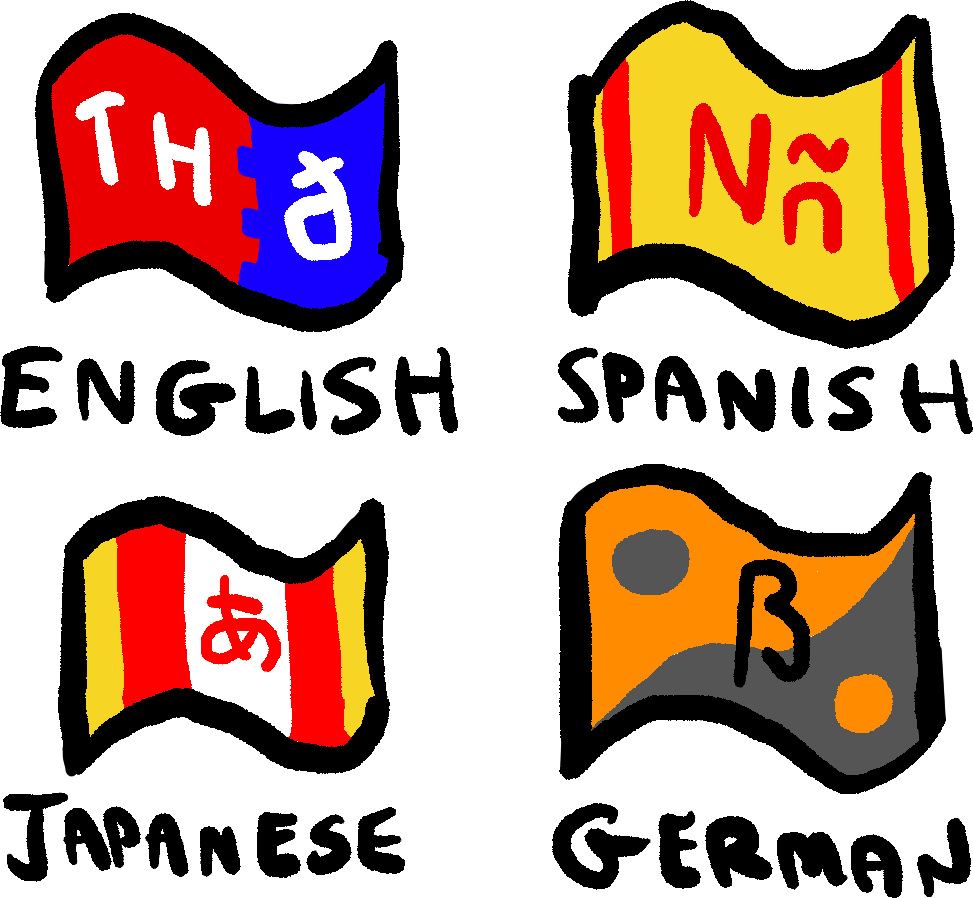
Maybe the real solution is that languages should have flags, and they should be decoupled from any specific country! This is such an obvious solution that it’s amazing that it hasn’t already been implemented.
Let’s just pick a distinctive feature of each language and use that to make a new “language, but not country” flag (Figure 2).
One Final Adjustment:
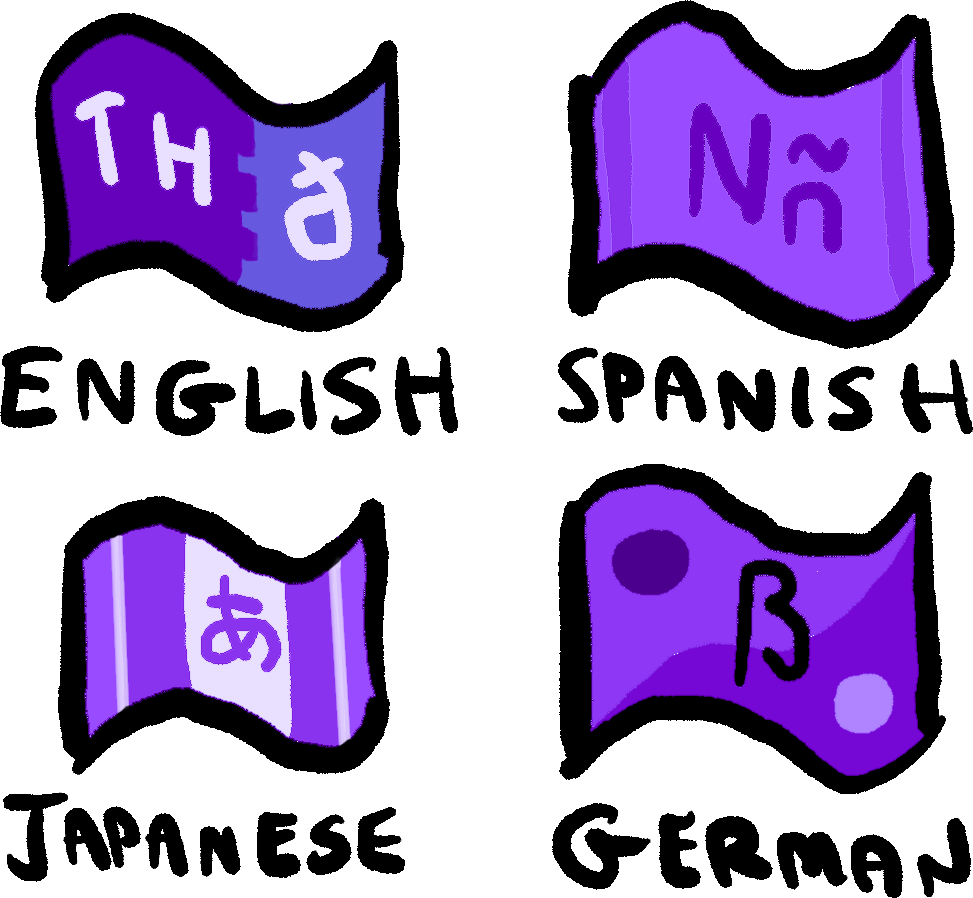
The flags above look like plausible national flags. If we want to make it super obvious that these are language flags, the easiest option might be to take advantage of the fact that purple is rarely seen in national flags.
So if we make our language flags using various shades of purple (Figure 3), it becomes obvious that they are language flags, and not national flags.
PROS: Ends language confusion and war forever.
CONS: Requires hundreds of new emoji. And now people will have to argue whether “English (Brooklyn)” gets a different flag from “English (Long Island).”
Originally published 2025-02-17.
 WorstPlans: updated every Monday since July 2014!
You must be logged in to post a comment.