

Background:
Imagine the following scenarios:
- A city needs a bridge built that 100,000 people will use per day. The city offers $5 / hour for someone to volunteer to design and build the bridge.
- A parent needs childcare, so they offer $10 / day. When a strange cult responds to the offer, the parent shrugs and hands over their children.
- A landlord needs a major electrical work done to a building. They pay $100 and attract a bunch of unqualified grifters who make dangerous modifications, and then the building burns down due to an electrical fire.
In each of these situations, you would probably say “if you want quality work, you’ll need to actually pay for it! What did these idiots expect when they offered such an insultingly low amount for an important job?”
The Issue:
Yet, when it comes to public officials, this is how most countries operate: a job is offered that is under high scrutiny and almost guarantees that a double-digit portion of the electorate will hate you no matter what, and the pay is usually ~10–20% of what the person could earn in a regular private sector job.
And then people are surprised when so many bizarre weirdos or unqualified independently wealthy hobbyists run for office!
Consider the salaries for a member of the U.S. Congress ($200,000 / year) and for the U.S. President ($400,000 / year). Now, check out vaguely equivalent private-sector jobs: the CEO of Nokia had a total 2023 compensation of ~$3.7 million, and the CEOs of Microsoft and Apple have previously made upwards of $50,000,000 per year! (Figure 1).

If you add up the total compensation of the Microsoft and Apple CEOs, it’s roughly equivalent to the entire total salary of all members of U.S. Congress together.
Proposal:
If we want to attract competent individuals that are 1) qualified, 2) are not also crazy, and 3) are not easily susceptible to bribery, we should just increase the pay rates for public officials by, say, 10x at minimum.
Consider the benefits: it’s much less likely that a senator who is making $2,000,000 per year (plus benefits) will be bribed vs. a senator earning $200,000 per year. Additionally, many politicians only dabble in politics because they’re already independently wealthy: by making the pay competitive, it would open up the field to competent-but-not-rich challengers.
Conclusion:
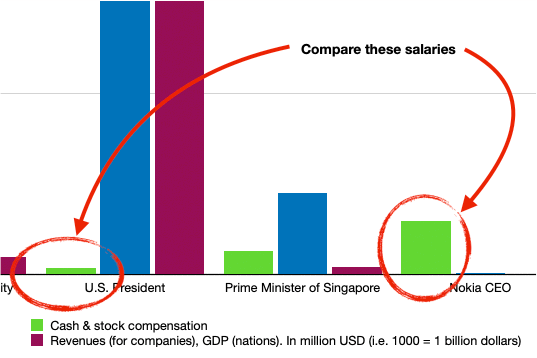
Note the “Prime Minister of Singapore” entry in Figure 1 (zoomed in slightly above): it’s a bit of an outlier in income, being $1.6 million/year, which is about 4-10x what most other countries seem to offer for an equivalent position. In other words, Singapore has already adopted this idea to some extent!
PROS: Although this idea SOUNDS like it would be expensive, it will probably save money in the long term due to the reduction in corruption.
CONS: Would probably be opposed by the rich and powerful, as they would lose a major competitive advantage in running for office (since it could greatly increase the number and quality of challengers for important political roles).
Originally published 2024-10-28.
 WorstPlans: updated every Monday since July 2014!
You must be logged in to post a comment.