
Background:
Many modern nations lay claim to ancient treasures—some of which are in the hands of other countries!
But sometimes it’s difficult to determine the “legitimate” owner of an artifact after hundreds of years.
Example:
Easter Island—which is owned by Chile—is the home of many famous stone statues (“moai”: 🗿).
If a UFO relocated all of those statues overnight to Australia, and, at the same time, a lawyer in Oregon discovered that he was the only remaining genetic descendant of the original inhabitants of Easter Island, we would have an interesting ownership dispute situation.
People would possibly use these ownership criteria to determine the “rightful” owner:
- A: Current Ownership: Historically, this was the only requirement! Winner: Australia.
- B: Cultural Significance: Neither country has any cultural connection, and the lawyer doesn’t know anything about Easter Island either. Winner: nobody.
- C: Control of the object’s original location: Winner: Chile.
- D: Ancestry: The lawyer in Oregon is the only known genetic relative. Winner: Oregon.
- E: Preservation of artifact: Unclear. Winner: nobody.
In the contrived example above, it’s likely that most people would support the return of the statues to Easter Island.
But this scenario could get a lot more complicated. What if we discovered that the statues had actually be carved in modern-day Oregon in 2500 B.C. (and were later relocated to the islands by canoe): does this bolster the claim of the lawyer?
The Issue:
Let’s work on a more complicated case study, and evaluate it at each point in history.
This study involves a fake Golden Goblet of Human Sacrifice (loosely inspired by https://www.google.com/search?q=human+sacrifice+in+carthage).

Part 1: 1000 B.C. Initial Setup:

Discussion question: Who is the rightful owner of the goblet at this point?
Part 2: 800 B.C.:
Here, we see that the Blue Kingdom has invaded the Gold Kingdom: the goblet-worshippers were banished to the deserts to the west (Figure 2, “D”).
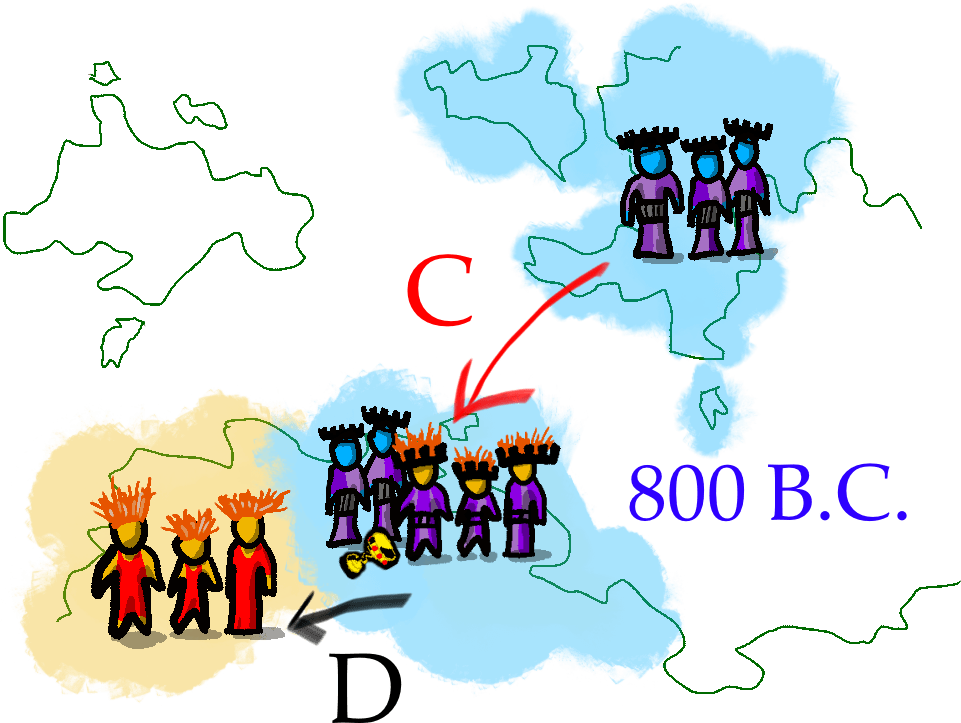
Discussion question: Who is the rightful owner of the goblet at this point?
- A: Current Ownership: Winner: Blue Kingdom.
- B: Cultural / religious importance: Winner: exiles (from the Gold Kingdom).
- C: Physical ownership of object’s original location: Winner: Blue Kingdom.
- D: Ancestry: Descendants of the original goblet worshippers exist in both locations. Winner: none.
- E: Preservation: Unclear. Winner: none.
Part 3: 1400 A.D.:
Almost 2000 years has passed, and goblet worship has gone extinct. The Blue Kingdom has fractured, and the northern half is now the Purple Kingdom (Figure 3).

The Blue Kingdom wants the goblet returned so that the king can melt it down and sell it as valuable scrap metal.
Discussion question: Who is the rightful owner of the goblet at this point?
- A: Current Ownership: Winner: Purple Kingdom.
- B: Cultural / religious importance: Winner: none. (Recall that the two kingdoms here are the same ones who exterminated the goblet culture.)
- C: Physical ownership of object’s original location: Winner: Blue Kingdom.
- D: Ancestry: Winner: Blue Kingdom. (The orange-haired people in Fig. 3 are the descendants of the original inhabitants).
- E: Preservation: Winner: Purple Kingdom.
Part 4: 1650 A.D.:
The goblet has been sold to the Green Island (Figure 4, F). The Green Island people incorrectly believe that the goblet is the Holy Grail, and consider the goblet to be a holy relic.

Fig. 4: The goblet has been relocated (the arrow marked “F”) to the Green Island.
Discussion question: Who is the rightful owner of the goblet at this point?
- A: Current Ownership: Winner: Green Island.
- B: Cultural / religious importance: Green Island citizens consider the goblet to be a holy relic, although they are mistaken about its actual origins. Winner: Green Island? Maybe. Do they still have a “cultural importance” claim if its based on a demonstrably-false belief about the object?
- C: Physical ownership of object’s original location: Winner: Blue Kingdom.
- D: Ancestry: Winner: Blue Kingdom (but it might require extensive genetic testing to determine ancestry after thousands of years).
- E: Preservation: Winner: Green / Purple.
Proposal:
Since there are so many competing parties with varying claims of legitimacy, it’s clear that the fairest way to solve this ownership issue is to create a game show where the disputed artifact is the prize. This way, everyone take an equal crack at winning it.
The game show will have three rounds:
- Quiz Round: This would just be a standard quiz game show, but with questions about the artifact. E.g. “what is it made out of,” or “what did the high priest use this artifact for.” Basic stuff.
- Cultural Importance / Practical Skills Round: Here, the contestants are evaluated on their ability to use the artifact in the proper cultural context. For example, if the disputed artifact is a statute, the contestants would just have to admire it. If the disputed artifact is a longbow once owned by Henry VIII, the contestants would need to demonstrate their proficiency in archery. If the artifact is a “goblet of human sacrifice,” the contestants would have to perform a mock (?) human sacrifice.
- Tiebreaker Round: Extreme Violence: Contestants can apply violence to each other until only one contestant maintains a claim. This represents the brutality of history and frequency of “might makes right” as a method for solving disputes.
Conclusion:
There are few problems that can’t be solved with a game show. This particular mix of mental challenges (e.g. the quiz) and physical challenges (e.g. the tiebreaker) also has precedent in “chess boxing” (https://en.wikipedia.org/wiki/Chess_boxing), which consists of alternating rounds of chess and boxing.

PROS: Ensures that the ownership of cultural artifacts isn’t determined by a country’s military might, but rather on its ability to field a champion with extensive knowledge and amazing fighting skills.
CONS: None! This should help resolve many international disputes.
Originally published 2024-05-06.
 WorstPlans: updated every Monday since July 2014!
You must be logged in to post a comment.